
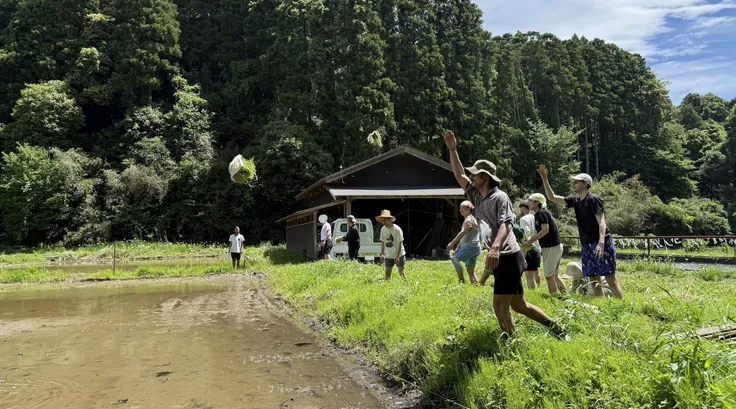
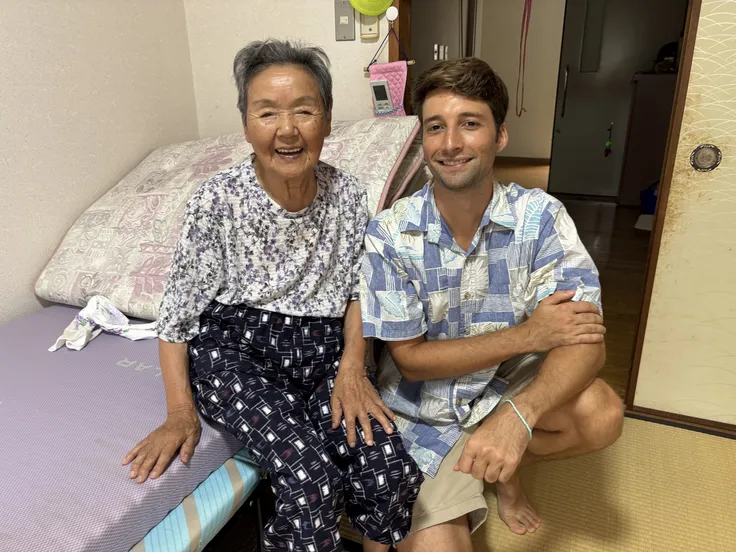
Ms. Nakayama was the first farmer I met in Japan, back in 2018 when I was an English teacher in Tokushima, long before I had any interest in farming myself. At first I could barely understand a word she said, but that didn’t stop us from becoming friends.
She was under five feet tall and strong as a wild boar. I watched her get stung by a Japanese killer hornet (オオスズメバチ, osuzumebachi) for the second time. At her age, it could’ve been a death sentence, but she barely flinched. These country grandmas are built different!
Her eyes were kind though. She guided me between the steep mountains and pointed out the edible herbs along the way. At least, I think they were edible—my Japanese was pretty rough then.
I remember on summer days, returning from work, she would often leave a baggy hanging on my door with fresh chirashizushi, a vinegary mixed rice dish inside. She shared the rare and stinky matsutake she’d foraged from the forest. She handed me piles of freshly boiled konjac.
At that time, I had no idea I was getting a glimpse into my own future as a small-scale, regenerative farmer in rural Japan.
- How and why I started farming
- Becoming a farmer in Japan
- Can you legally farm in Japan as a foreigner?
- What is farming like in Japan?
- What’s the future of farming in Japan?
- How you can give it a try
- Why all this matters
How and why I started farming
After two years, I had had enough of the English teacher life, and there was this urge to “prove myself” in the city. It was the cliche, another country boy following his dreams to “the Big Mikan,” aka Tokyo.
I moved into my shoebox apartment and cried on the first night. The grandmas working at the old-style coffee shop in my building didn’t seem to like foreigners, which was a bummer.
My Tokyo side-quest lasted five years, in which I made money and lived “the dream” as a high-rolling recruiter. In fact, I was on a rollercoaster.
The first year I lost money because I chose to live within walking distance to the office. I kept grinding away, and finally the results came in my third year, when I started making the equivalent of over six figures in US dollars, and then subsequently doubling and tripling that. In the end, I had the 19th floor suite overlooking Tokyo Tower, could buy expensive dinners without looking at the price, and bumped shoulders with CEOs in the sauna of the premium gym I had joined.
I decided to move to seaside Chiba to get away from the city, and try to figure out what I wanted next.
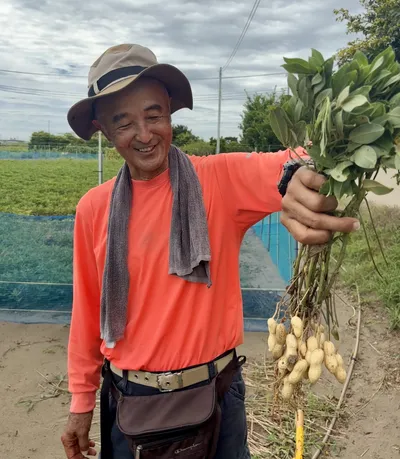
While I was exploring the area, casually looking for an abandoned house, I crossed paths with a friendly old lady who was peeling peanuts. I asked if I could help and she smiled.
As we sat peeling in the crisp fall air, she peppered me with questions. Luckily (or unluckily), my Japanese was much better than when I was friends with Ms. Nakayama, and I understood everything she said.
Her name was Kiyomi and her husband was Yoji. They’d moved from Tokyo 10 years ago after retirement to be closer to nature and start farming. Kiyomi prefers the city as she likes to eat fancy dinners, but she said they would remain in the countryside because it was Yoji’s dream, after so long in the city.
They asked me to stay for dinner that night. She texted me later asking if I wanted to help again, this time on the farm. I showed up to a very sandy field and we planted some onions. They were these delicate little green and white strings, which we carefully laid into holes. It was a little monotonous, but kind of meditative.
I started helping them more often, and there came a pivotal moment when I was still employed at my Tokyo company. On a morning check-in call with the team, I held my phone in one hand, while my other hand was planting little daikon seeds.
A young woman on my team told me, “Levi, you sound different.” I explained, apologies, it’s because I’m outside and it’s a bit windy.
She replied, “No, like you sound . . . happy.”
Holy shit, I thought. She was right. Being outside and doing physical work was making my stress melt away.
Next thing I knew, I quit my job, backpacked around for a year, went to some retreats, started a farm experience business, and returned to feeling like myself. There is something about working the land that has been deeply healing to me.
Becoming a farmer in Japan
I’m grateful for the opportunity, but honestly, I’m not sure I want to be a full-time farmer. Their offer did make me realize, though, how many chances there are like this around Japan.
The caveat is that you probably need to speak Japanese as a baseline, and you need to spend years building a relationship as an apprentice or volunteer so that they trust you. Farming especially is an industry without many clear future succession plans.
Can you legally farm in Japan as a foreigner?
It’s actually difficult to own farmland for anyone, even as a Japanese person. You must be registered as an official farmer in order to purchase farmland, and even then the local Agricultural Committee has to approve each transaction.
Rezoning land from agriculture to residential or vice versa is extremely difficult, too. That means vast amounts of land in Japan are off-limits in general.
On the flip side, becoming a farmer is getting easier every year. The requirements used to be higher. For example around 10 years ago you had to be managing about 2.5 acres to register as a farmer, but recently they did away with the limit. Nowadays, you just have to submit a business plan, and you are likely to be approved, regardless of nationality.
Of course, a suitable visa is necessary, and if you come into a town with no Japanese and no contacts, I doubt they will approve you. It’s best to show up in the community, get an introduction to the proper people at city hall, and be able to explain your plans in Japanese, or at least with a friend that can translate.
Again, Japanese nationality is not written explicitly as a requirement for the funding. I went to my city hall the other day, and they seemed extremely supportive. They even offered to help me look for a house with farmland, and promised to fast-track my application. I plan to apply this August, so fingers crossed! If you are genuinely interested in this work, there are a lot of opportunities.
What is farming like in Japan?
First of all, I am not a full-time farmer. If I’m honest, trying to make a living growing food sounds terrible. You’re chasing profits at the whim of the forces of nature, and the margins are ridiculously low. The peanut-farming couple are in the red every year.
Like them, I do it as a hobby and as a lifestyle. For the past few years I have volunteered at their farm every Tuesday. For a while, I also did a half day on Thursdays at an organic farm nearby, too. Both of these have given me valuable knowledge, strong community connections, and places to decompress.
Now, I am managing my own small piece of land, which I tend to roughly an hour a day.
Peanut farming (their way)
Farming activities really depend on what type of farming you do. Kiyomi’s main goal is to make food that tastes good. They don’t care about organic this or that, it’s all about flavor to them. Yoji was a scientist, so he knows the exact chemical concoctions needed to make the plants produce.
They do sell their produce, but that barely covers the cost of the inputs. Kiyomi usually spends her peanut revenue on a monthly trip to a fancy Italian place called Ushimaru about an hour north of us.
At the peanut farm, the year goes something like this.
Spring
Early spring involves carrying heavy 50 liter bags of chicken manure, limestone, kome nuka, and fertilizer to spread around the field. Then, we use a small machine to till the land, aerate the soil, obliterate the weeds, and mix in the fertilizer.
In May, we plant peanuts in the ground, first coating them in a fiery red dye and fungicide to ensure they germinate and don’t get eaten by crows.
Summer
The beginning of summer is rainy so we don’t do much on those days. On dry days there’s some weeding.
The second half of summer is all about harvesting. First it’s green beans and zucchini, then it’s pumpkins, watermelons, okra, peppers, eggplants, cucumbers, carrots, figs, apples, pears, sweet potatoes, and finally, peanuts. About 75% of the field is peanuts so it takes a long time to get through, and we have to harvest quickly between the typhoons. We often have more volunteers for this part, but be warned, it is really hot.
Fall
By autumn, peeling and processing peanuts is the main work—they get sent to a roaster, and then we bring them back to seal into bags. But there are still plenty of things to harvest and it’s time to sow winter vegetable seeds like cabbage, lettuce, beets, turnips, broccoli, cauliflower, garlic, and various onion varieties.
Winter
At this point the peanuts have been roasted and sold. The pace slows down a bit, and we prune the trees and burn the branches in big piles around the farm. They host a rice cake-pounding event (餅つき, mochi tsuki) at their house for kids in the area. My favorite part of winter is when they order fresh oysters from Hiroshima and we have an oyster party.
Regenerative farming (my way)
We had a talk one night about succession plans, and they asked me to inherit the farm within five years. I told them I wasn’t sure, but that I am open to trying.
As a start, they are letting me “experiment” with my own little piece of land. It’s less than 500 square meters, which is big for a garden, but small for a farm. Their total farm is about five or six times that, and they don’t use a tractor.
On my experimental plot, I decided to try things my own way, in a regenerative farming style. A conventional farmer asks, “What can I kill today?” and uses chemicals to hunt down the fungus, bacteria, or insects that are pestering the crops. A regenerative farmer asks, “What can I support to live today?” and provides homes for beneficial insects, to help nature return to a balanced ecosystem.
When you realize that the pests are usually only attacking because the system is out of balance, then it makes sense. If we’re stuck in a mindset of “Productivity over all,” and “Everything has to be perfect,” then we are asking to be disappointed.
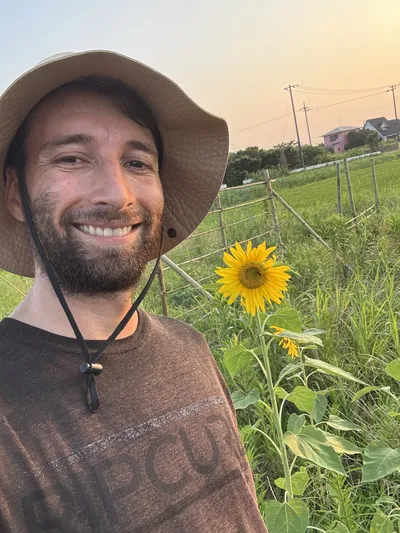
In practice, this means I’m much more patient and open to weeds (aka lazy), and not always planting in straight rows. Maybe it’s less productive, but it feels more fun and even creative. They think I am completely crazy, but I am blessed that they are letting me continue, despite the neighbors surely talking about the crazy foreigner with the wild-looking farm.
Because I try not to buy any inputs, I have to think outside the box, and rely on my surroundings more. I harvest leaves from the local forest, collect straw from rice farmers, chop down bamboo for building projects, and compost my food waste. My friend Tim is even helping me construct a compost toilet.
This is my first growing year and I made the mistake of trusting ChatGPT with natural farming advice, which led me to wasting all of March scattering seeds around, with almost none germinating. I had a bit of a disadvantage since the farmers had sprayed Weedkiller RoundUp all over the plot to “sterilize it” and keep the weeds down. That instantly kills the helpful microbes, too. It would’ve been fine if I had bought bags and bags of inputs, but I didn’t, and so my daikon suffered.
Where I did go on a crazy shopping spree was Mercari. I probably bought over a hundred dollars worth of colorful heirloom seeds: rainbow beets, turnips, purple green beans, round carrots, etc. Almost none survived. That was heartbreaking, and, I’m told, a common initiation experience for a first-year gardener.
Since then I’ve been learning more and more, but still fail constantly. I made a beautiful bamboo trellis for my cucumbers and they all died. (But there is still time to plant more!) Tomatoes and basil have been decent, and I am hopeful for my okra. Edamame were a huge success—I wish I had planted more.
Now I pray I can harvest at least one of my 40 sweet potato plants. I planted some blueberries, blackberries, loquat fruit, feijoa, and mandarin oranges. Again, I’m trying to build a diverse ecosystem, not a monocropped ecological wasteland.
Over time, as things return to the natural way, the soil fertility should improve, and the weeds should go down. Luckily, I’m not in a rush. My mission is to be able to provide food for myself, my family, and friends. I do not want to sell food because I know my mind will start chasing productivity, rather than enjoyment.
Will my “lazy farming” prevail?
There’s a sad tension to this process, where I wish I could learn from the grandparents, but our styles are too different. I’ve stopped trying to explain why I don’t weed my fields bare, roll out sheets of black plastic, or buy chemicals from the store.
I think they are convinced I will fail, and if I continue long enough, I’ll eventually come around to see that their way is the best. Part of me wants to prove them wrong. Honestly, though, I’d rather be aligned and have someone teach me this stuff rather than relying on YouTube. Maybe I can be that mentor for someone someday.
I hope to show people we can provide abundance for ourselves even as “lazy farmers.” I call it “lazy farming,” but if you want to grow, you have to plant the seed. There is always some work involved, but natural farming is an investment in nature, rather than running on a hamster wheel trying to fight against it.
What’s the future of farming in Japan?
The big shift is that most farmers are retiring in the next 10 years, which means most food will be imported. This change is already underway, starting a couple of years ago—just check the supermarket! I think Japan needs more small-scale and community farms, or else food quality will drop.
Developments in regenerative farming
Regenerative farming is a “new” concept to modern Japan, although ironically it was how people farmed here for thousands of years, until the invention of petrochemical products around the 1940s.
A local example
I often partner with a woman named Ayako Saito, who is the founder of Minamoto Farm. She supplies vegetables to restaurants and cafes here, so everyone knows her. She’s been interviewed by news stations as she is a rare young farmer in her 40s. The Patagonia store even gives her free merch, and they are talking about an official sponsorship.
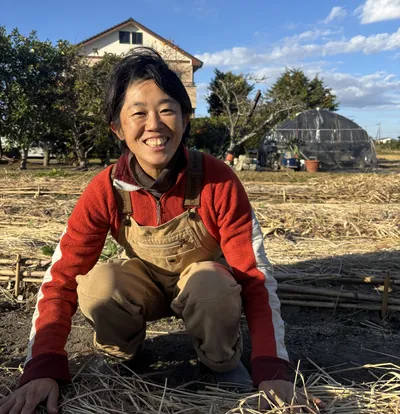
Since she moved out here from Tokyo 15 years ago, Ayako has always been an organic farmer. However, even she has changed her mindset. It used to be all about production, and she would spend a lot of money on organic fertilizers and organic pesticides, etc. This increased yield, but it also increased reliance on supply chains. With rising prices, it’s tough for many farmers to afford these inputs, and despite her efforts she was seeing decreasing results, with more pests and susceptibility to climate effects.
As a result, nowadays she is pushing to source more things locally. For instance, people in town rake up their dead leaves and prune tree branches, and then either burn them on the spot, or put them in plastic bags for the city to incinerate as burnable garbage. But this “waste” is priceless to a natural farmer. Leaves and branches are precious green manure, slow-burning fuel and mulch for plants.
This is one of the many mindset shifts that we love, which we call “thinking circularly” (or also “being cheap”). We really have everything we need all around us. I personally am trying to train my instincts to source from my environment, rather than default to going to the store.
People say there are challenges to scale. I’m not an expert, but when people tell me, “You can’t feed the world like that,” I smile and say, “Good thing I only have to feed myself and my family.” Either way, as a small or hobby farmer, seeing the environment improve over time feels deeply meaningful.
The implications of new technology
Robots and AI are sure to change things here in Japan—hopefully with the guiding principles of natural farming, and not the outdated industrial systems that are killing us.
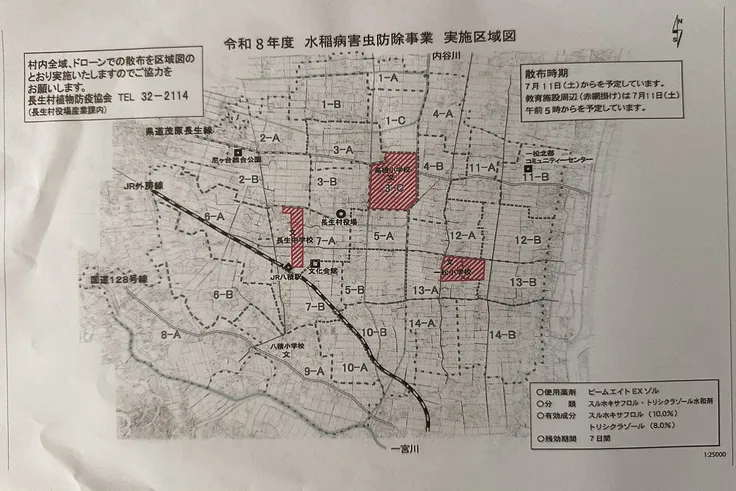
Unfortunately, the drones that are spraying in our town (and many others around Japan) are using things like neonicotinoid pesticides, which have the side effect of killing off beneficial insects and pollinators like bumblebees.
A study by JStage, which goes through the known effects of neonicotinoids, found that they are not only destructive, but that native Japanese honeybees were 8–14 times more susceptible. According to the article, “Toxicological implications of neonicotinoids on endemic vertebrate species in Japan could be more severe than what is reported in other species worldwide.” The study also showed that over 90% of tea leaves have neonicotinoid residue. In fact, every single fruit and vegetable they tested, besides nectarines and tomatoes, had one or more detectable neonicotinoids.
To “be safe,” pesticide drones don’t spray over schools. How do they control where the wind blows, and make sure there aren’t pregnant mothers around? They do their best to wait for low wind days and send out flyers to warn residents. I guess they are trying, but it would be cool if they just stopped spraying poison everywhere.
One example would be using drones to spray helpful microbes like Lactobacillus (yes, the same thing we drink in Yakult, and the main microbe that helps us make Japanese pickles and sauerkraut). When microbes like these are added back into the soil, they increase water retention, meaning that the land is less likely to flood and it is more likely to stay moist underground, even during an intense drought period. Microbes in the soil also sequester carbon from the atmosphere, reducing greenhouse gases. Finally, in a healthy farm environment, there is more diversity of microbes, plants, insects and animals, which leads to less catastrophic crop failures as pests are unlikely to take everything out at once.
Nature is complex, but it is a truly resilient system. The good news is that working with nature is actually easier and more efficient, but it takes some fundamental mindset changes. At the moment, there is a huge mindset shift from killing microbes to bringing more life into the soil. I’m hopeful.
How you can give it a try
Personally for my future as a farmer, while the world goes headfirst into AI and automation, my plan is to double down on in-person experiences.
I’ve been hosting farm visits, rural adventures, and digital detox retreats to help people heal their minds and regenerate themselves in a literal sense. I’ve seen firsthand the good that can come from stepping out of the daily grind, and I want to continue to show that to others.
And of course, you are always welcome to join one of our events to test the waters. Starting this year Ayako and I are hosting a series of workshops dedicated to soy beans (大豆, daizu) which will show people how to plant, harvest, and process them into tofu, natto, miso, etc.
Why all this matters
I feel these kinds of Japanese cultural skill-sharing workshops are super important, not just for fun and for preserving tradition, but because they literally help us survive. In the event of some disaster or global meltdown, I’d want to know how to grow food, preserve it, build structures, make fires, etc.
Even without a catastrophe, living in a community that cares about the same things is rewarding, and I want to share that with more people. It’s not like we live in a walkable village, with craftsmen at every corner—but maybe someday we’ll get there. At this point, what we do have is a strong group of surfers, organic farmers, goat farmers, carpenters, tech workers, investors, and community organizers/connectors like myself.
Although this is a very small and modest way to do so, at least we are doing something that gives us life. We are beginning to get organized about it, too. We may start an NGO soon.
If you come to Japan, or are already here but want to live differently, I encourage you to get involved in whatever you are passionate about—there’s probably an obaachan somewhere who would love to show you the ropes!