
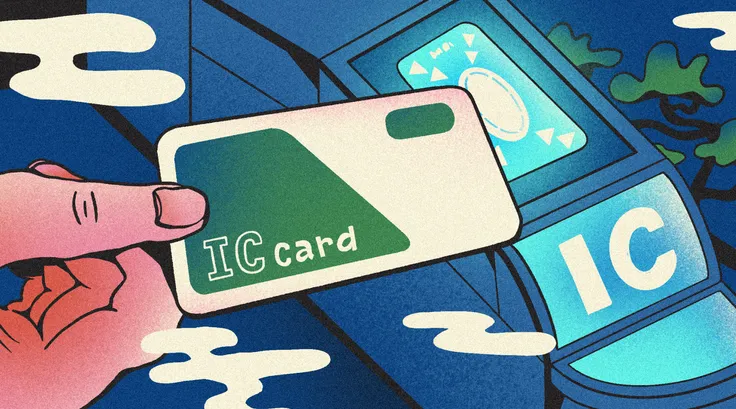
If you’ve ever ridden a train in Japan, there’s a good chance you’ve held a Suica card in your hand and tapped it against a station gate.
Even though it was developed back in the 90s, Suica’s technology is really impressive even by today’s standards. Every time you tap it, a complex transaction happens in the fraction of a second, without needing a battery or live internet connection.
It’s easy to take IC transit cards for granted now that they’re part of everyday life, but let’s not forget how much work went into engineering them several decades ago before cashless or contactless payments were common.
Here’s a breakdown of how these cards work, and the surprisingly bumpy story of how they came to be.
- How the cards actually work
- How stations worked before Suica
- Initial resistance
- Success in Hong Kong
- Back to Japan: Upgrading the card
- Critical performance issues
- Naming the card
- Launch day
- What happened next
How the cards actually work
Every Suica card has a chip storing two things: a unique card ID, and your current balance. Both of those live on the card itself, rather than a central server.
The cards have no battery and aren’t self-powered in any way. Instead, the reader on the gate emits an electromagnetic field that powers the card just long enough to complete the transaction.
Why not sync with a central server each time? The reason is simply that it would take too long.
With the sheer volume of people passing through Tokyo’s stations each day, calling a server would be extremely risky. Transactions would take longer, causing people to slow down at the already-crowded station gates. And any network issues like latency, packet loss, or server downtime would cause the gates to shut down, which would be disastrous during peak commuting hours.
To prevent that, the card and terminal handle everything between themselves. The individual gates do sync with central servers to save transaction logs, but only periodically, rather than in real time.
How stations worked before Suica
For several decades, trains were operated by a government-owned entity called Japan National Railways. In 1987, it was privatized and split into the regional JR companies that we know today, including JR East and JR West.
Back then, a lot of train stations in the Tokyo area didn’t even have automated gates. They were manned by staff who physically punched holes in passengers’ paper tickets with a hand clipper. As you can imagine, this wasn’t the most efficient setup and caused massive bottlenecks during rush hour.
Meanwhile, over in the Kansai region, several private railways (such as Hankyu) were using magnetic ticket gates—the same kind still used today, where you feed a ticket into one end of the machine and pick it up after it pops out the other side.
JR East, now in charge of train stations in the booming Tokyo metropolitan area, was thinking hard about what it could do to modernize. Two of their biggest goals were to:
- Relieve congestion at stations to make train travel faster and more convenient.
- Cut maintenance costs. The existing ticket machines worked well, but had tons of moving parts and sometimes suffered from jams and breakdowns.
So the company started researching a long-term solution. Several companies approached JR East with ideas, and one of them proposed something quite ambitious: using contactless integrated circuit (IC) technology.
That company was none other than Sony.
Initial resistance
Sony had actually started researching and developing IC cards in 1988, but not specifically for trains. Their main use case was for logistics. The idea was to attach wireless tags to boxes and parcels so that a reader could identify them from a distance, without needing to unpack or scan anything by hand. The technology behind this was FeliCa, Sony’s proprietary contactless system.
Sony built FeliCa to process data quickly and securely over short distances. Seeing potential in their product, they pitched the idea of contactless transit cards to JR East.
JR East said no.
They liked the concept of contactless cards, but the actual technology at the time simply wasn’t advanced enough to meet the speed and reliability demands of Tokyo’s massive train network.
JR East also was hesitant to invest billions of yen into unproven IC technology when Kansai’s magnetic ticketing system was already proven to work. And that’s exactly what they ended up using instead: in the early 1990s, JR East installed the same magnetic gates in Tokyo, finally replacing the human ticket-punchers.
Meanwhile, Sony nearly gave up on FeliCa. They tried finding other uses like access-control systems for buildings, but didn’t have any luck. After a period of fruitless experimentation, an unexpected opportunity came along . . . from outside of Japan.
Success in Hong Kong
Over in Hong Kong, a conglomerate called Creative Star (known today as Octopus) was looking to adopt a fast, unified transit card that could work across multiple types of transit, including trains, metros, buses, and ferries. They were exploring contactless technology, and that’s exactly where Sony found an opening.
The Octopus card launched in 1997 and was a massive success. Three million cards were issued within the first three months, and the technology proved to be reliable enough to handle millions of passengers every day.
While all of this was going on, JR East had been running its own internal trials, and was gradually starting to warm up to Sony’s now-proven technology.
Back to Japan: Upgrading the card
Eventually, Sony and JR East officially partnered up. But even after Octopus’s success, there was still lots of work to do.
Sony needed to upgrade the technology to meet JR East’s requirements and adapt it to the realities of Tokyo’s rail network. As you can imagine, Tokyo’s sheer scale and density entailed quite a lot of technical challenges.
The biggest challenge was speed. JR East’s gates handled absolutely ridiculous passenger volumes during rush hour. To avoid dangerous bottlenecks, the company set a non-negotiable rule: the entire transaction had to happen in under 200 milliseconds.
At first glance, that might sound less impressive than Octopus, which used a chip that could respond in under 100 milliseconds. But the two numbers are actually different benchmarks.
Octopus’s 100 millisecond target referred only to the radio communication between the card and the reader. It didn’t include the subsequent fare calculation, as that depended on the rest of the transit system. For the record, Octopus’s full end-to-end transaction reportedly takes around 300 ms.
On the other hand, JR East’s 200 millisecond window had to cover everything, including the card-to-reader communication and the fare calculation. So Suica’s target was actually tighter.
Hitting that target was no small feat. It involved detecting the card, authenticating it, calculating the fare based on entry and exit data, and then deducting the balance—all made much harder due to Tokyo’s sprawling web of JR lines, subways, and private railways all tangled together.
To hit the 200 millisecond target, the card and reader had to handle the entire transaction locally, rather than trying to reach a backend server.
This was especially tricky to implement because the card had no internal battery, and was powered entirely by the electromagnetic energy from the gate. So everything had to happen during the tiny window when the card is tapped on the reader and receives power for a split second.
Sony also gave the reader itself a communication range of 85 millimeters, which was double that of rival contactless systems at the time. This might sound like a minor tweak, but it actually mattered a lot. A longer range meant that the transaction could start earlier and finish faster, letting passengers walk straight through the gate without having to stop and carefully line up their card perfectly.
Critical performance issues
After all that hard work, the project encountered a dire situation. When they started testing prototypes of the card-reading touch panels, the performance was abysmal, with an error rate significantly higher than the original magnetic tickets.
Shinji Yamanaka, an industrial designer who worked on the panels, mentioned retrospectively in his blog how severe the problem was. He wrote that “Nearly half of the testers couldn’t get through the gates,” and quoted an executive who complained, “It only worked for me once every five tries. A 20% batting average.”
The failure rate was so high that leadership was ready to pull the plug on the whole project. Yamanaka and his team were brought in as part of a last-ditch effort to save it—and they delivered. It turned out that the problem wasn’t really with the technology itself, but rather with how people were using it.
The original readers were completely flat and didn’t clearly signal to passengers what they were supposed to do. Many users treated them like a barcode scanner. They would swipe the card too fast, or hover it too high above the pad, causing the reader to throw an error.
One idea was to add an explicit “tap here” message on the panels, but this alone didn’t actually solve the problem. After developing four new prototypes and having users test them at a public exhibition, Yamanaka and his team analyzed the footage and found the brilliantly simple solution: to tilt the reader at a slight angle.
With the redesign, the error rate plummeted to under 1%, and the project was saved. That design was later patented and is still the standard used for IC card readers today.
Naming the card
JR East held a public competition to decide on the new card’s name and branding. The winner was none other than Suica, the name that we all know and love today.
The iconic penguin mascot was an existing character created by picture book illustrator Chiharu Sakazaki, and it was adopted to help make the new and unfamiliar technology more friendly and approachable.
JR East backed it all with a series of quirky ads and commercials.
Launch day
Project leader Akio Shiibashi originally set a symbolic launch target: January 1, 2001, the first day of the new millennium.
But as it often happens with big technical projects, preparations weren’t finished on time, so the launch shifted to November 18, 2001. When the day finally arrived, 3,200 gates across 424 different stations in the Tokyo metro area went live, all at once.
One small mystery with Suica’s launch is that JR East manufactured a huge number of physical cards ahead of time and stockpiled them in warehouses, but did not pre-issue them before the launch. There’s no official statement about why this happened, but there are some plausible explanations given how the cards work.
Each physical card has its own ID stored on the card itself, and each card needs to be activated before it can be used. When you buy a physical Suica card at a ticket machine, activation happens during the purchase. But that activation requires the actual network to be live. Although JR East could manufacture and store the cards ahead of time, they couldn’t pre-activate them because the system wasn’t running yet.
It’s also worth noting that while they did do field testing via employee trials and controlled passenger trials, there was never a public soft launch. The whole system essentially went live in one big move.
What happened next
In the beginning, Suica was solely a transit card, usable only at stations operated by JR East. But it didn’t take long to turn into the multifunctional Suica that we know today.
In 2002, Suica became usable on the Tokyo Monorail and Rinkai lines. In 2004, it received e-money functionality, transforming it into a flexible prepaid card that could be used at shops, restaurants, and vending machines. Naturally, this came with some more lovely commercials.
In addition to being one of the first successful cashless payment methods for consumers, it became a major source of revenue for JR East. When you pay with Suica, the merchant pays a transaction fee of between 2 to 3.2%, similar to a credit card.
A few years later, in 2006, Mobile Suica was launched. This was ahead of its time, letting passengers load Suica onto their phones even before the smartphone era. It worked thanks to a system called osaifu-keitai (おサイフケータイ, wallet phones), which was supported on many flip phones back in the day, and was also powered by the same FeliCa chips.
Not stopping there, JR East developed its own line of credit cards called View. These can be linked to a Suica card to enable automatically charging it when its balance drops below a certain amount. This was also revolutionary for the time, as it completely removed the need for cash, ticket machines, and unneeded mental bandwidth.
From there, Suica’s underlying technology was adopted by the rest of the country, leading to the launch of new IC cards like PASMO and ICOCA.
Initially, each card was locked to its own network:
- Suica worked only on JR East
- PASMO worked only on Tokyo’s subways and certain private railways and buses
- ICOCA worked only on JR West
But eventually, nationwide mutual usage was implemented. Now, any card can be used on almost any train or bus across Japan, with only a handful of exceptions. Nearly everyone using public transportation in Japan is now using IC cards or their smartphone equivalents, and we have the hardworking engineers from the 1990s to thank for it.
Today, all modern iPhones around the world support FeliCa out of the box, letting travelers add Suica cards to their Apple Wallets. Android is a bit trickier since FeliCa is only supported on phones sold in Japan, or on select models. For better or worse, this means that many international travelers still have a reason to get the physical card.
Speaking of which, there are signs that the industry is moving away from dedicated IC cards. Several rail operators around the country, including Tokyo Metro, Toei Subway, and Hankyu, have rolled out credit card tap-to-pay terminals. JR East itself hasn’t joined, but is working on its own gate-less walk-through system using the Suica app and location data. Neither of these means that the physical cards will be discontinued, but they do point to a future where the card itself becomes just one of several options.
Final thoughts
Suica’s launch is a story that spanned well over a decade, involving rejected pitches, an unexpected detour in Hong Kong, and many other trials and tribulations.
Perhaps the most impressive part of the story is that it wasn’t just about that card. The entire system, including JR’s network, infrastructure, and hardware, was all developed and rolled out in one go across one of the world’s busiest rail networks. The 200 millisecond response time is still incredible by today’s standards, and Suica remains one of the fastest transit cards in the world more than 20 years later.
On a sadder note, the beloved Suica penguin will soon be retiring. After 25 years, the mascot will be phased out in spring 2027, and the successor will be chosen by public vote.
So the next time you tap your Suica card at a train station, take a moment to think about all the hard work that went into it, and also be sure to thank the penguin for its many years of service.