
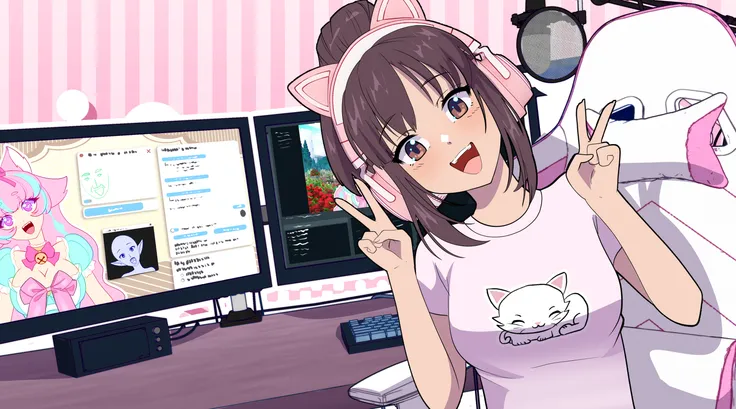
VTubing is an online activity in which performers use animated models to portray themselves onscreen. Software such as Live2D Cubism allows the animated avatar to echo the real-life movements of the actor behind the camera.
Since Japan is where VTubing first took off, it’s not surprising that Japanese VTuber companies still dominate the industry. However VTubing is increasingly drawing new participants from all over the world, particularly from the US.
To gain more insight into how VTubing is evolving worldwide, I interviewed a range of industry professionals: a former hololive employee, an artist who works for multiple English-speaking (EN) VTuber teams, and several multilingual VTubers.
- In brief: What is VTubing, and why do people do it?
- VTubing in Japan
- VTubing outside Japan
- The making of an EN VTuber
- The future of VTubing
In brief: What is VTubing, and why do people do it?
“I would like to change people’s perception of VTubers,” said Sakuraha Rua, one of the VTubers I interviewed.
Sakuraha, alongside Amikoto Ash and Tsunano Toro, debuted online together in December 2025 as “Omen,” the newest generation of talents from VTuber agency Astraline.
“As big as VTubing has become at the end of the day,” Sakuraha went on, “in the grand scheme of things, it’s still considered a niche. There are people out there who will see an anime avatar and just not take it seriously. . . . [They] think we’re hiding behind an avatar, when I think it’s just as much of a valid way to be a content creator and express yourself as showing your face.”
“The assumption,” said Sakuraha, “is that one chooses to be a VTuber to make up for something that they don’t have, when that’s simply not true.”
I know so many VTubers who are so pretty in real life that I think they would be more popular if they showed their face. It’s just a choice, right? You would prefer to have this character represent you, whether for privacy . . . [or] to perform as a character.
The draw of creating a character
A character typically has a name, backstory, and personality separate from that of the performer. VTubers may create and play multiple characters throughout their career, either for agencies or for themselves. If the VTuber is employed by a large corporate agency, the agency usually owns the character and any IP associated with it.
Creating and playing a character is the big draw of VTubing for Sakuraha’s fellow Astraline member, Amikoto.
“It’s easier to play a character,” said Amikoto, “when I’ve got the costume, the makeup, the mask, and the wig, as it were. . . . I could be a face cam streamer and still play a character, per se. But there’s something about VTubing and the extent to which you can change your appearance and become a character from an animation [that’s] intriguing, especially to me, as I’m ultimately a voice actor more than anything.”
I like the freedom of expression that you’re afforded when you’re playing a 2D character. You can be a lot more eccentric and expressive and a lot weirder with it.
What do they do?
It’s difficult to generalize what VTubers do with their digital avatar, since there are always interesting niches and exceptions to the rules. Typical VTubers, though, are known for three activities: livestreaming in character, creating videos, and performing at “live” concerts.
While remaining in character, many VTubers will host long livestreams, sometimes more than eight hours at a time, to interact directly with their fans. Usually they play video games while chatting with viewers, but they may also watch TV shows, share their backstory or lore, and collaborate with other VTubers.
VTubers will also create videos for their channel that feature them singing covers or original songs and performing short skits, again frequently in collaboration with other VTubers. The ratio of livestreaming-to-video-creation varies: some VTubers focus more on streaming, others on content.
Particularly in Japan, prominent VTubers—mainly those affiliated with the two biggest agencies, hololive and NIJISANJI—use 3D motion capture technology to hold live concerts and other “in-person” events. Event participation numbers can be quite high: at the two-day hololive SUPER EXPO 2025, they estimated around 35,000 people attended.
While Sakuraha and Amikoto can speak Japanese, they aren’t originally from Japan. However, their fellow VTuber Tsunano Toro is a Japanese national who grew up observing the activities of professional VTubers.
“I was more of a viewer,” she said, “watching hololive and thinking they were cute and cheering them on, rather than wanting to do it myself. . . . I’ve admired people who upload songs and are active on YouTube for maybe 10 years, since I was a student. But, you know, it costs a lot of money.”
Then Merryweather [Astraline’s founder] asked me, and I thought, if I start this activity, maybe I can fulfill the things I wanted to do 10 years ago. . . . You only live once, and I thought that this opportunity must be fate or destiny.
VTubing in Japan
As Tsunano indicated, VTubing is well-established in Japan, which isn’t surprising given that the initial VTubers were Japanese.
Curiously enough, the very first VTuber is Japanese, but performs in English. Ami Yamato, a Japanese native living in London, debuted her animated vlog in 2011 on YouTube. Currently her channel has around 140,000 subscribers.
The first VTuber to go viral though—and to use the expression “video YouTuber”—was Kizuna AI, who debuted on YouTube in 2016. This time, Kizuna was not the work of a single person, but a persona created by the digital production company Activ8. Kizuna AI’s avatar is 2D and heavily anime-influenced, as are most VTubers now.
Since then, VTubing as an industry has grown exponentially. By the end of 2024, there were roughly 60,000 VTuber accounts in Japan.
“I think [the number has] gone up,” Sakuraha told me, “but they just don’t get seen because the competition is so high.”
It’s almost impossible to stand out unless you join a corpo, or you get really lucky and get a viral hit. But that’s like winning the jackpot.
“Corpo” VTubers
By “corpo” Sakuraha is referring to the major corporate VTuber agencies, two of which in particular dominate the Japanese industry.
To learn more about how the big agencies work, I interviewed “Yuki,” a former employee at hololive who agreed to contribute their experience anonymously.
A top-down management style
As one might expect, the big VTuber agencies are as profit-driven as any other talent management agency in Japan. Their attitude toward the talents is “Do your job and get on with it,” said Yuki.
That message goes over better with Japanese VTubers than with those from overseas. In fact, according to Yuki, many of the local talents welcome the direction.
Japanese Vtubers are much more aware of Vtuber culture stemming from idol culture. You’re being hired to do a job. That job is very creative, passion-driven, and fun most of the time, but you’ve got to do what you’re told.
However, “Ninety percent of the time, that does not mesh well with overseas VTubers.”
To facilitate their international expansion, hololive formed two groups speaking other languages, hololive English and hololive Indonesia. NIJISANJI meanwhile has NIJISANJI EN (English-speaking) and VirtuaReal (Chinese-speaking) VTuber groups. NIJISANJI also had Indonesian and Indian groups but closed them in 2023.
Many of these overseas VTubers, according to Yuki, felt personally invested in their characters and their audience. They wanted more creative input, but “it doesn’t feel very creative to convince four layers of Japanese managers to do something.”
Of course, there are also significant benefits to working for a big “corpo” agency. Exactly what percentage of the take agency VTubers earn isn’t clear, but in 2024 top hololive talents like Usada Pekora, Minato Aqua, and Houshou Marine were estimated to generate several million dollars each from Youtube super chats and ad revenue alone.
Yuki pointed out that bigger agencies also mean better technology. For example, hololive has its own bespoke Live2D program, and its parent company COVER Corporation also built the biggest 3D motion capture studio in the country, which is what enables hololive VTubers to “perform live” in concerts.
Doing big business
Another advantage of being “corpo” is the greater chance of seeing your name in lights. NIJISANJI, hololive, and their VTubers have become regular players in Japanese entertainment and business.
“You see VTubers on McDonald’s adverts,” said Yuki.
One thing that stood out to me was how frequently VTubers were featured on company goods. . . . You could go to any convenience store and buy merch or products with VTubers on it.
Because VTubers are widely accepted, the cooperation extends both ways. “In Japan,” said Yuki, “You can approach a brand and say ‘We want to stream your game,’ and they’ll say, ‘Yeah that’s cool.’” Overseas game companies are much less accommodating, in Yuki’s experience, partially because they’re not familiar with these companies that have become household names in Japan.
One reason it’s been easy for Japanese corporations to accept VTubers is the country’s preexisting fan culture. “[VTubers are] an extension of idol and anime culture,” Yuki said.
Probably to the [collaborating] company, they just see, ‘Oh, it’s an IP.’ They don’t care if it’s a VTuber, an anime, or a manga.
Small agencies and indie
Smaller Japanese agencies also exist, though they claim a correspondingly smaller share of the market. Yano Research performed an interesting survey in 2022, in which they asked 894 VTuber fans whether they recognized the names of different VTuber companies.
And while Sakuraha compared being an indie success in Japan to “winning the jackpot,” some Japanese indie VTubers have done just that.
A good example of two prominent Japanese indie VTubers are Ponpoko and Peanut-kun, two real-life siblings who perform together as “Pokopea.” They’ve been creating videos since 2018, and though neither of their Youtube channels have broken one million subscribers, they’ve enjoyed collaborations with major companies like JR West and NTT Docomo, as well as with VTubers from both hololive and NIJISANJI.
When I asked Yuki about indie VTubers in Japan, he was of the opinion that, while overpowered by the “corpo” VTubers, if indies are able to generate the intensive fan support known as oshikatsu (推し活), they may still be able to make a living.
It’s easier to have a small cult following in Japan that gives you money, whereas in the West they may not actually give you money.
Oshikatsu and why it matters
In 2016—just around the same time that Kizuna AI was taking off—the word oshikatsu (推し活) appeared.
Oshi (推し) refers to your favorite star, idol, character, or group, and oshikatsu can be loosely translated as “activity for one’s idol.” The term became a trending hashtag in 2018 and was named “Japanese word of the year” in 2021. Though a relatively new phenomenon, oshikatsu is not confined to younger age groups: a 2024 survey revealed that 46% of women in their 50s support an oshi.
That support isn’t always financial. Activities as diverse as writing fanfiction, promoting the oshi on social media, and attending concerts are also considered oshikatsu.
Fan spending, however, is significant. A survey suggested that the average amount a fan spends on their oshi every year is around 250,000 yen.
VTubing outside Japan
While around 35% of VTubers still hail from Japan, the number of VTubers from English-speaking countries is rising. An estimated 19% of VTubers are from the US; if you add in VTubers from other mainly English-speaking countries, the percentage increases to almost 27%.
Of course, some of the top English-speaking talents are actually employed by hololive and NIJISANJI, who as mentioned above have hired overseas VTubers to expand their global reach. Of the top ten EN VTubers in Q1 of 2026 (calculated by hours watched), four of them were affiliated with Japanese agencies.
Out of the remainder, six were independent, and one was affiliated with Phase-Connect, a Japanese-English agency based out of Canada.
Culture differences
Some of the differences between JP (Japanese) and EN (English) VTubing are straightforward. YouTube Live is overall the most-viewed VTuber platform, but that’s largely due to its popularity amongst Japanese VTubers. English-speaking VTubers are more likely to stream on Twitch, and Chinese to stream on bilibili.
Other differences are more subtle and stylistic. “There definitely is a difference,” Amikoto confirmed. “I feel it can be hard to explain. . . . Of course Japan has a more hardcore idol culture than overseas.”
A lot of VTubers overseas will publicly talk about their husband, their wife, their boyfriend, their girlfriend, but in Japan, most VTubers will hide that with their life because if that’s found out, their career could be over.
Sakuraha added, “On the [English-speaking] side, VTubing feels more like regular streamers and content creators just choosing to be a VTuber. The kind of content that they make and the way they approach their branding is the same as if they were just a normal streamer or content creator that shows their face.”
Because so many of the biggest [English-speaking] creators are just like regular creators, it’s not as much of a formula. People kind of just do their own thing.
An indie-dominated industry
One of the most striking contrasts is that VTubing outside of Japan is largely an indie market, rather than one dominated by large agencies. As Sakuraha pointed out, “It’s hard to distinguish whether the difference [in styles] is because of EN and JP, or because it’s corpo and indie.”
Larger-scale VTuber agencies have been tried outside Japan, but not with great success so far. VShojo, an American agency, held 5.7% of VTuber stream viewership in Q3 of 2024, making its talents the most-watched corporate VTubers after hololive and NIJISANJI.
But by July of 2025, VShojo found itself embroiled in scandal. Ironmouse, a top talent with over two million Twitch subscribers, accused VShojo of withholding funds: an unnamed amount for herself, and over 500,000 US dollars she’d helped raise for the Immune Deficiency Foundation.
Ironmouse’s announcement about the missing funds, and her split with the agency, triggered a departure of almost twenty other talents, many of them also citing missing payments. Virtually nobody remained with the company, and in a matter of a few days, the agency was shut down.
Some smaller agencies are trying to bridge the gap between “corpo” and indie, and also the JP and EN markets. Astraline, the company employing Tsunano, Amikoto, and Sakuraha, is technically a VTuber agency based in Japan. However, it was founded by Merryweather, a Danish VTuber who performs in English.
Previously Astraline focused almost entirely on other English-speaking talents, with backstories based on Northern European lore. This newest generation sports Japan-inspired designs and performs in both English and Japanese, in a clear attempt to overcome the EN-JP cultural divide.
Is there money in it?
According to Yuki, another difference between JP and EN VTubers is that oshikatsu remains a Japanese phenomenon.
Overseas [fans] are willing to put in the time and actually to put in the effort as well . . . but they’re not willing to put in money, and they’re not willing to spend money on plastic [merchandise].
Some of the biggest indie talents are generating plenty of revenue, although it’s difficult to quantify exactly how much. One study found that the average monthly livestream earnings for VTubers in 2023 was 2,667 US dollars. However, the median income was only 127 dollars a month, suggesting that top talents scoop up most of the pot.
Another way to get some sense of income potential is from charity streams, which publicize the amounts earned. In March 2025, Nimi Nightmare did an eight-hour charity livestream to benefit the St. Jude Children’s Research Hospital and raised over 360,000 US dollars, setting a new record for funds raised in a single VTuber charity stream.
As indies without agency support, however, these VTubers are also on the hook for initial investment and ongoing expenses. These don’t just include the model themselves, but also marketing, software subscriptions, content creation, hardware upgrades, merchandise, and original artwork. A basic beginner’s set up might be a few thousand US dollars, while a fully-professional set up could easily run 10,000 US dollars or more.
Tsunano pointed out that this contradicts one common assumption about indie VTubers, which is that they’re jobless and living at home, and therefore have plenty of free time on their hands. “People who are really unemployed probably can’t do it because they don’t have the money,” she said. “So I think it’s the opposite of what people think, that they’re doing this because they don’t have [other] talents, or that they’re doing it because they’re unemployed.”
I think a lot of them are actually working hard at their jobs, or balancing it with their daily lives and work.
The making of an EN VTuber
For an insider look at the EN VTuber scene, I spoke to Spookypandagirl, an illustrator and animator who works with a number of successful English-speaking VTubers, including Vexoria the Sun Eater, Suto, Spite, Mamavale, Megalodon, and Trickywi.
“I was quite flabbergasted when I first started working with VTubers,” Spooky said, “because I was very much outside of the VTuber sphere before I started getting work from them and hearing about all the work that goes into it. It’s super exciting. Also, really intimidating. I don’t know how they do it.”
Teamwork makes the dream work
“ It’s not just a talent who is the VTuber, and a model,” Spooky elaborated. “It is whoever designed the model, then whoever made the model ready for rigging, whoever rigged the model, whoever made the screen overlay, whoever did any music—a lot of these VTubers have their own music.”
It’s a whole team behind one VTuber that manages to make it huge and a sensation and the fun character that we see on the stream. I think many VTubers, especially in the West, really respect and appreciate [artists] because without that team, they wouldn’t exist.
“ The VTuber themselves is the one who finds you,” Spooky said. “Sometimes their manager will, but often it’s the VTuber.”
[They say] ‘I like this artist. This artist works well. You know what? I’m going to give you all the work and I love you.’ They are so welcoming, and you kind of get adopted. I’m part of several ‘VTuber families.’”
It can easily take a dozen different creatives to fulfill standard VTuber design needs, but each one gets a nod for their efforts. “Whenever [VTubers] do a debut and it’s been a big event, they actually do a thank you segment where they go through slideshows and they thank each person who’s worked on it individually. It takes forever to get through because so many people work on it, but they take the time out to show the fans exactly who’s done what.”
No AI Allowed
The tight-knit relationship between indie VTubers and their creative teams may be why generative AI is heavily discouraged, by both VTubers and their fans.
“None of the talents I work with have ever used generative AI to my knowledge!” said Spooky. “It’s a huge ‘no-no’ in the VTubing sphere, as so many of their assets, models, merch and graphics are all created by trusted human artists who they have come to rely on.
Basically, using AI is something that can be seen as disrespectful to artists, who helped build the VTubing industry in the first place, as well as lazy or lacking in creativity and inspiration.
Finding their own voices
The work schedule can be chaotic—Spooky sometimes has only a few days or a week to deliver animated videos, for example—but at least there’s only one layer of “management” to satisfy.
“I think the fact that the [talents] have total control,” she said, “and they’re not being dictated to on how to do things, allows for flexibility and last-minute decisions that can make a project really shine. You don’t have to wait for a production pipeline at all. . . . And that’s part of the success and why it’s so fast growing.”
She noted that indie English-speaking VTubers have begun adopting more unique styles, differentiating themselves from their Japanese counterparts. “The VTubers I work with are the product of the western subculture of VTubing, where they aren’t afraid to say a racy joke or to get a bit flirtatious and be a bit more chaotic.”
The ones I tend to work with are kind of counterculture, because they’re not trying to be anime. They’re just being really chaotic silly performers with an anime avatar, and that kind of dissonance works well.
Is the market oversaturated?
While Spooky herself is able to earn money working as a freelancer for these indie VTubers, she cautioned that new VTubers shouldn’t expect to make much money at first. “The market anywhere on the Internet is now so oversaturated that it takes a lot of hard work to get noticed.
“But it’s one of the rare spaces where I do believe perseverance will make you shine eventually. . . . One of the things I really like about the VTuber space is, a lot of the bigger VTubers might find you—because they actively watch other VTubers—and will offer to do a collab. So it’s a very nice, welcoming space in that sense.”
You never know who’s going to make it big, because you never know who’s going to get noticed.
The future of VTubing
Of all the people I interviewed, none expressed doubts about VTubing’s future in general. Most believe that VTubing won’t just continue to expand to new countries, but also to other industries and modes of entertainment.
“Maybe they’ll appear on TV or something,” said Tsunano. “Maybe they’ll start appearing in variety shows, with comedians, or with idols for example.”
Yuki agreed on that. “[VTubing] will become even more mainstream in Japan. It will be on TV.”
On the whole, Yuki is very cautiously optimistic. “It’s not in its prime, it’s matured in its market, but at the same time it’s still growing in certain areas.”
For the huge companies I think they’ll continue to grow, and they’ll expand into anime and video games, and manga as well. They’ll become part of pop culture like Hatsune Miku.
They’re not just referring to Japanese pop culture either: “I see it being integrated into more promotion in the West.”
Technological advances could open up fresh possibilities, Sakuraha believes. “ You are very confined as to what you’re able to do when you’re just a 2D VTuber. So in order to expand the type of content you’re able to create to keep up with the market, I feel like more and more people are going to try and do 3D stuff, especially now that there are more options for different types of 3D tracking.”
Spooky, on the other hand, thinks that even indie 2D VTubers could easily make the creative leap to become their own transmedia IP.
So not only is this character on Twitch or in a webcomic, it’s also on YouTube. It’s on TikTok. It has a music album you can buy. It’s in a video game. It’s got a mobile game. . . . You can go in so many different directions if you know what you’re doing.