
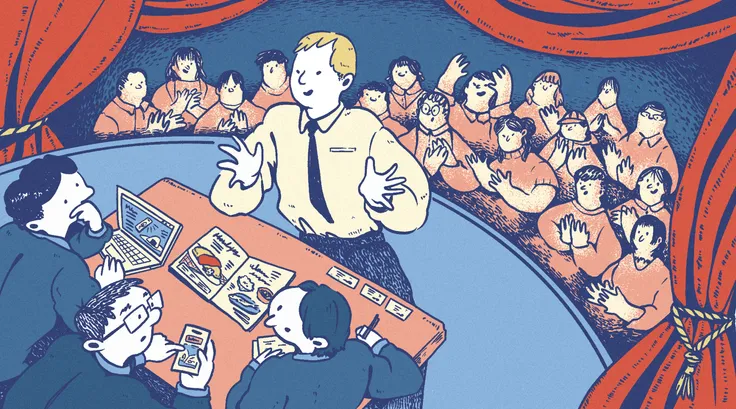
The Senior Vice President from AXA wanted a demo. Right now, in this meeting room, with little warning.
I was Head of Product at Asken Diet at the time, and this was one of those meetings that gets whispered about in Slack beforehand. AXA was exploring our diet app as an employee health benefit for their workforce.
Landing a partner that size would have been more than a revenue bump: it would have raised the ceiling on what my small company believed it could become. So we had over-prepared the deck and the talking points, even designating who would speak in what order.
What we had not prepared was food.
It was 2017 and we had just shipped photo recognition, built with Sony: point the camera at your plate, the app names the food, and the work of logging a meal drops from a dozen taps to a few effortless seconds. The SVP wanted to see our diet app work, including the newly-released (beta) photo recognition. But no one from my team thought to bring in dishes of real food to demo that function.
I scanned the room and saw the bookshelf. Cookbooks. We were a nutrition company, so naturally someone had filled a shelf with them as decor. I pulled one down, found a glossy full-page shot of a meal, and slid it across the table. “Try it on this,” I said.
That’s how a Senior Vice President ended up taking a photo of a photo of food.
The app completely misidentified the dish.
There is a specific feeling I know well from twenty years of improv comedy: the half second after something goes wrong on stage, when the audience is watching you to see whether this is a disaster or the best part of the show. The answer is almost always up to you.
So, I did what I do every month in front of a paying audience. I accepted the new reality and built on it. I explained, half knowing and half guessing out loud, that the model was reading printing dots and page glare instead of the depth and texture of real food, which is why it does better on an actual plate.
Then I turned the failure into the point. This was the system in its worst case, a photo of a photo, and it still returned a structured guess in seconds.
The rest of the meeting was pivots and reactions—reading his face, adjusting the pitch live, handing moments to the right colleague. It felt less like a business meeting than an improv scene where the stakes were a corporate partnership.
We got the deal.
Walking out of that room, I understood something I had somehow missed for two decades.
My 20-year double life
The two hats thing might need some explaining.
I moved to Japan in 2005, a punk music fan from Minnesota who has spent 20 years trying to convince Japanese friends that Minnesota is a real American state worth visiting. (Success rate to date: low.) I landed in Osaka, and that same year I founded an improv group called the Pirates of the Dotombori.
In 2010 I moved to Tokyo and founded the Pirates of Tokyo Bay, an English and Japanese improv comedy group that has performed monthly ever since, currently at What the Dickens! pub in Ebisu. In 2012 the Pirates and I appeared at TED@Tokyo, TED’s talent search event, with a talk called “Why You Won’t Die On Stage.”
I didn’t invent that title as a metaphor. Dying on stage is the fear nearly everyone brings to their first improv class: I’ll freeze, the audience will watch me fail, I will die up there. The talk was about why it never actually happens, and about what performing unscripted comedy in two languages, for audiences that rarely share a first language, teaches you about failure that no book ever managed to teach me.
By day, those same 20 years were spent in the Japanese tech industry. Product at Asken, the diet app. Then conversational commerce at Zeals. Now I’m at Peatix, the event and ticketing platform, where I lead product. My working hours are filled with specs, roadmaps, KPIs, sprint planning, and stakeholder reviews, almost all of it on mixed Japanese and international teams, where the hardest problems are rarely technical.
For a long time I kept the two lives strictly separated, partly out of a vague fear that “improv guy” would undercut “product guy” in a Japanese business context. The AXA meeting collapsed that wall. Since then, I have taught versions of this material on GLOBIS Unlimited, the online arm of Japan’s largest business school, and in corporate workshops for organizations from Google Japan to the US Embassy in Tokyo.
But the honest laboratory is still the monthly show, where I test in real time whether these skills hold up under pressure. They do, and they are trainable.
Habit 1: Hear what goes unsaid
What surprises people most about improv is how much of it is listening. Everyone assumes improvisers are quick wits pulling lines out of thin air. In practice, the second you start writing your next line in your head, you have stopped hearing your scene partner, and the scene is already dead.
Audiences can’t always say why a scene went flat, but they sense it right away: two people are performing private scripts at each other. Your funniest possible line is worth less than actually hearing the person in front of you.
Now put that in a product meeting.
As a PM, I walk into cross-functional meetings carrying my own goals and KPIs. So does everyone else. Sales has a number. Engineering has a limit on what they can build. Business development has a partner they promised something to. Everyone shows up with an outcome already written in their head, so everyone is one bad habit away from killing the scene, by waiting for their turn to talk instead of listening to what is said.
The meetings that actually go somewhere have at least one person listening and adjusting live, finding an alignment that nobody’s prep contained. I try to be that person. I learned how to listen on a stage in Osaka, not in a product course.
On a mixed Japanese and international team the skill matters even more, because so much of the signal lives in what is not said. Japanese business culture expects you to read the room (空気を読む, kuuki wo yomu). When someone tells you politely “That might be a little difficult”, they are not inviting you to solve the difficulty. You just got a no, a firm one, wrapped with care. Same with the nodding silence after you present a plan: it is usually not agreement, it is people choosing not to embarrass you in public.
Assuming silence equals consensus is the trap that catches foreign PMs and developers more than any other. I have watched projects sail through a review without a single objection, then quietly die over the following month. The objections were real. They were just never going to be voiced across a conference table.
And on a team operating across English and Japanese, it catches translation gaps constantly. An embarrassing amount of cross-cultural conflict turns out to be two people marching ahead on different readings of the same sentence. Saying it back catches the mismatch while it still costs nothing to fix.
Habit 2: Unlearn the “Yes, But” reflex
Improv’s most famous rule is “Yes, And,” which means to take whatever your partner gives you, then add to it.
On stage, the opposite move is called blocking, and it is scene murder. Your partner says “Wow, the moon’s gravity feels weird today,” and you answer, “We’re not on the moon, this is a Saizeriya.” Their idea is gone. You erased it, and the whole room feels the air go out.
What makes “Yes, And” powerful is not politeness. It distributes the creative load. No single performer has to drive the story, because everyone adds details, little by little.
In our shows, scenes usually start grounded in reality. “Let’s go shopping.” “Yes, and today is the day I finally spend my giant jar of one yen coins.” Two offers in, we are wheelbarrowing coins into Don Quijote, and the scene has an engine no one person built.
At work, the block wears a business-casual disguise: “Yes, But.”
Listen for it in your next roadmap review. Someone pushes back on a spec, and the defensive reflex fires. “Yes, but we already validated this.” “Yes, but that’s out of scope.” Each “Yes, But” is a small block that turns a potential collaborator into an opponent, and the meeting into turf defense.
The reframe I practice is treating pushback as an offer. When an engineering lead challenges my spec with a performance concern, the “Yes, And” version is not to defend the spec. It is, “Yes, and I’ll scope that concern into next sprint’s planning as its own line.” The concern is real, it lives on the roadmap, and it has a concrete next step. The person who pushed back is now invested in the plan instead of braced against it.
An honest caveat, because this is where “Yes, And” gets misused: it does not mean saying yes to everything. A scene still needs a consensual reality, so agreeing with every idea produces chaos, not comedy, and a product is no different.
^”Yes, And” is a posture toward people, not a policy of accepting every feature request. The input is real, and gets a place in the system. That is different from promising it ships.
Japan adds another layer. In some ways “Yes, And” fits a consensus culture perfectly. Nemawashi (根回し), the practice of quietly building agreement with each stakeholder before the official meeting, is essentially “Yes, And” performed in slow motion across a week of one-on-one conversations. You gather offers, incorporate them, and arrive at the meeting with a proposal everyone has already shaped.
But there is a clash hiding inside the fit. The Western startup version of “Yes, And” often sounds like “Let’s just say yes and figure it out as we go.” To a Japanese team that reads as reckless, a plan with no owner for the risk.
In the other direction, the indirect Japanese “no” can masquerade as a “yes” to a foreign ear. You end up building on an offer that was never actually accepted.
The way I square the two is by matching speeds: hold on to the accepting posture from improv, but do the building at nemawashi speed, not brainstorm speed.
Habit 3: Make the background janitor shine
The most counterintuitive thing improv taught me was that the best scenes almost never belong to the person trying to be funny. They belong to the person making everyone else look good. New improvisers think stage time and line count equal value. Years in, you notice what actually elevates a show.
Some of my favorite moments in 16 years of Pirates shows have involved performers playing silent background characters. Two performers are locked in a tense argument, and a third walks on as a janitor. Sweeping. Saying nothing. Reacting with only their eyes to everything being said. The audience melts, because everyone has been that janitor, the fly on the wall trapped in someone else’s drama.
Without one line of dialogue, the janitor makes the argument funnier, the stakes realer, the whole scene bigger. The improv phrase for this ethic is “Don’t be clever, be useful.”
Product management is the janitor role with a job title. A PM has responsibility without authority. You cannot code the feature, design the interface, or close the enterprise deal, and you cannot order the people who do. You succeed by making other people effective and making sure their work is seen. The engineers, the designers, the sales team: they are the scene.
One concrete place this shows up at Peatix is RICE, our prioritization framework (Reach, Impact, Confidence, Effort). The scoring math matters less than who holds the pen, because a different group owns each component. Business and sales own reach and impact, engineering owns effort, and product facilitates confidence. No team can push a pet project through alone, because the score is literally co-authored.
My job in that system is not to have the best ideas. It is to run a process where every team’s expertise visibly shapes what gets built, so a high-priority project is one several teams already feel they own before a line of code exists.
This is also the habit where improv and Japanese workplace culture are not in tension at all. Group harmony over individual grandstanding, the team’s result over personal credit, the discomfort with self-promotion: the ensemble instinct that improv spends years training into Westerners is closer to the default setting here. As a foreigner, leaning into it is one of the highest-leverage cultural adaptations available to you, and unlike honorific Japanese, you can start on day one.
Habit 4: “Fail joyfully,” an ocean apart
Every month, I bomb in front of a paying audience.
Not the whole show, usually. But in any improv show, some scenes just die. A premise doesn’t land, a game collapses, a joke receives silence. The gift of doing that monthly for 20 years is that you learn, in your body rather than your head, that failure is survivable and usually informative.
That is what “You won’t die on stage” means. You won’t. You never do. The audience forgets the dead scene by the next one. What they remember is whether you panicked.
The sharpest version of this lesson came in 2016, when the Pirates toured New York City. Improv runs on audience suggestions, and after a decade of polite, family-friendly Tokyo ideas, we were suddenly harvesting them from New Yorkers. I will not print the specifics on a respectable website. The vulgarity was a genre shift we had not rehearsed. For the first stretch of the first show we were deer in the headlights, confident veterans instantly reduced to beginners.
What saved us was the same move I used with the cookbook: accept the new reality and build on it. We leaned into who we actually were, which was a Japan-based group, not all native English speakers, and visibly scandalized by what this audience considered a normal thing to yell at strangers. Our genuine flustered innocence became the comedy. New York, a city that respects nothing except commitment, was won over. The failure wasn’t an obstacle to the show. It was the material.
At work, this maps to the practices everyone claims to believe in, like blameless postmortems, shipping to learn, and separating “The thing failed” from “I am a failure.” The line I use with my teams, at Peatix now and at Zeals before, is that we are not building rockets. Zoom out and we run a ticketing platform. If something breaks, nobody is harmed. We fix it, we learn, we adapt.
And with AI-assisted development compressing the “build, fail, rebuild” loop, the cost of an individual failure keeps dropping. The pressure people carry is usually far larger than the actual stakes, and saying so out loud is a leadership act.
But I want to be honest about the friction, because this is the hardest of the four habits to import into a Japanese workplace, and pretending otherwise is how foreign leaders fail at it. “Fail fast, fail loud” and “psychological safety” are deeply American exports. In many Japanese work contexts, public failure carries a real social cost, face matters, and the safest individual strategy is to never be attached to anything that visibly broke. You cannot fix that by putting “psychological safety” on a slide. A value that took American tech culture decades to half-adopt ca in a Tokyo office over one offsite.
Two things make it actually importable. First, precision about what psychological safety is not; the goal is failing without fear, not failing without consequence. Japanese engineering culture’s seriousness about quality is an asset. You are trying to remove the fear, not the rigor.
Second, it has to be paid for by the leader first, which brings me to the habit.
One job, two hats
Improv never handed me a productivity hack. What it did was force me, month after month for 20 years, to drill the soft skills everyone in tech agrees matter, and almost nobody trains.
You can read a hundred articles about listening and psychological safety. Standing in a packed pub in Ebisu with no script, next to a scene partner improvising in their second language, you don’t just read about those skills. You use them or you die. (You won’t die.)
The four habits, stripped to their handles:
- Say back what you heard in one sentence before you respond. It forces real listening and catches translation gaps early.
- Swap “but” for “and” for one week. Pushback is an offer, so put it on the roadmap instead of blocking it.
- Name who deserves credit, in public. A PM’s authority is made of other people’s successes.
- Share your own mistakes first, out loud. Safety gets imported one leader-failure at a time, starting with whoever has the most status in the room.
None of these require talent, English, Japanese, or a sense of humor. They require reps. I got mine on stage; you can get yours in your next standup.
A hobby I picked up in college, the least career-focused thing I have ever done, turned out to be the foundation of a career leading software products an ocean away from Minnesota. I spent years thinking I was living a double life. It was one life. It was always one job.
And if you ever want to watch the training ground itself, the Pirates of Tokyo Bay perform every month at What the Dickens! in Ebisu, in English and Japanese, with no script. Bring a suggestion. But please, keep it cleaner than New York did.