
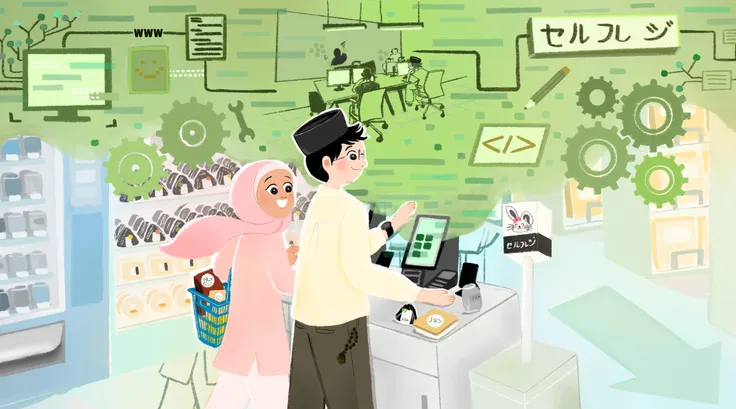
I moved from Indonesia to Japan in June 2025 to work as a software engineer at Rakuten, one of Tokyo’s major tech companies. As a Muslim, I was concerned about how I’d manage daily prayers, find halal food, and observe Ramadan while living and working in a country where Muslims are a small minority.
Fortunately, my experience has been overwhelmingly positive. My workplace provides prayer rooms, accommodates Friday prayers, and offers halal meals. Outside work, I’ve found a welcoming Muslim community, although everyday life still requires some adjustments.
In this article, I’ll share what it’s been like living and working in Japan as a Muslim software engineer, including the challenges I’ve faced and how I’ve managed them.
- Being Muslim in Indonesia vs. Japan
- Daily Life as a Muslim in Japan
- Working as a Muslim at a Japanese Tech Company
- Finding Islamic values in Japanese culture
- Challenges of Living in Japan as a Muslim
Being Muslim in Indonesia vs. Japan
This means significant infrastructure is provided for the Muslim community. Indonesia has Islamic education all the way from kindergarten until the university level. At each level, Islamic subjects are taught intensively, with both theoretical and practical aspects.
We have hundreds of thousands of mosques and musholla (smaller versions of mosques) to accommodate prayer and Islamic-related activities. There are also plenty of options for halal foods, which are food and drinks that don’t contain pork or alcohol and are served in an Islamic way.
We too have a range of Islamic holy celebrations and even national holidays for them. For instance, during the holy Eid al-Fitr at the end of Ramadan, Indonesia has dedicated at least three days off for all its citizens, not only Muslims, to celebrate with their families at home. The unique thing about Eid al-Fitr in Indonesia is that people who work in different cities than their city of origin usually will go back home and get together with their parents, neighbors, and relatives. This phenomenon is widely known as “homecoming” or mudik.
In essence, as a Muslim, living in Indonesia is very convenient.
Daily Life as a Muslim in Japan
Having moved to Japan, this is no longer the case.
I moved to Japan with my wife in 2025, and we decided to live around the Takatsu ward in Kawasaki City, Kanagawa Prefecture, on the Den-en-toshi line. The reason was straightforward: it’s close to my office as well as being in good proximity to Tokyo.
We chose this because we had just started learning Japanese, so we thought it’d be essential to have English-speaking services nearby for our daily life necessities. Also, while more mosques are starting to be built in different big cities in Japan, I needed to find one within commuting distance to accommodate my Friday prayers. In my experience looking for mosques in Japan, they welcome all Muslims regardless of branch. To do that, staying within the Greater Tokyo Area was the realistic choice.
Finding Mosques and Prayer Rooms in Japan
I found out that Japan’s big cities have a good number of mosques when I visited back in 2024 as a tourist. During that time, I visited cities like Tokyo, Osaka, and Kyoto. That gave me a little bit of assurance that, at least in the major cities, I can find a mosque for Friday prayers—an occasion in which a Muslim man performs a collective prayer every Friday afternoon with a minimum of 40-ish people. That’s the only “hard requirement” I need to fulfill.
Elsewhere, when I was returning to Indonesia from the Osaka Kansai Airport (KIX) in 2024, I was surprised that the airport had its own prayer area. The place was quite big, at least 20 meters by 40 meters as far as I can remember.
As I visit more places as a resident, I discovered that one of the malls in Shibuya, Shibuya Parco, there is a dedicated prayer room with an ablution facility, or wudhu. This made me realise that, not only is the government open to accommodating Muslims, but the private sector is starting to do the same as well.
Finding Halal Food in Japan
In Islam, halal refers to food and beverages that meet specific criteria that can be summed up as:
- Cleanliness: The environment used to prepare the ingredients must be clean.
- Humane slaughter: Meat must be slaughtered and prepared according to Islamic guidelines.
- No forbidden substances: Pork, intoxicants, and alcohol are forbidden.
In terms of food, I initially only chose Asian or Indonesian stores that clearly sell halal-certified food or ingredients. However, after a few weeks of exploring various options, I discovered that some popular Japanese stores also provide Muslim-friendly products. To name a few:
- Gyomu Super
- OK Store
- Tokyu Store
- Shinjuku Halal Food
These are stores that I can easily reach via train or bus, or are within walking distance, which makes my life a lot easier. I can choose among those depending on my budget and preferences. Recently I found that even convenience stores sell halal snacks and drinks.
This gives me greater peace of mind that Japan is becoming more and more Muslim-friendly, not only for visitors, but also for its residents.
Finding a Muslim Community in Tokyo
In my first year here, I attended the celebration of Eid al-Fitr at Masjid Indonesia Tokyo (MIT), a mosque built by the Indonesian Embassy in Meguro, Tokyo for all Muslims residing in Japan.
One thing that was memorable for me: during the morning rush hour on the day of Eid al-Fitr, there were Japanese staff members, I believe sent by the local government, who stood by the bus stop near Meguro Station showing a sign for the “Eid al-Fitr bus schedule.” This ensured that people who wanted to perform Eid al-Fitr prayers knew which bus to take to bring them to the closest mosque, in this case MIT. This was such a nice gesture from the Japanese government.
I also frequently visit Tokyo Camii Mosque, a Turkish mosque located in the strategic area of Shibuya, Tokyo. It’s not only for praying; this mosque also has a halal market on the first floor, at which I often see not only international Muslim residents but also Japanese people who want to shop for halal food, snacks, and drinks.
Working as a Muslim at a Japanese Tech Company
As a Muslim software engineer, I’ve found that my company, Rakuten, has been accommodating. I have also heard from a friend at another large Japanese company that they are also accommodating. Everyone at Rakuten, from my teammates to my managers, are very tolerant of my situation.
Prayer Rooms and Friday Prayers at Rakuten
First things first, the company provides a dedicated prayer room for both men and women. There’s also an ablution area.
Another thing that I am super thankful for is the ability to repurpose the meeting room to be a “temporary” mosque, so that every Friday afternoon we can use it for Friday prayers. So every Friday afternoon from 12–1 p.m., we transform the meeting room for Friday prayers, accommodating around 100 people in two batches (from 12–12:30 p.m. and 12:35–1 p.m.).
Of course this isn’t always as smooth as it sounds. Sometimes there are challenges. For example, one time the meeting room was booked by high-level executives for an important meeting. At that time, the HR department was kind enough to book another room, and inform the Muslim community beforehand so that we could use this other room while the usually-allocated room was used for another purpose.
Clothing
In terms of clothing, generally I see no issues around Muslims wearing clothing that adheres to Islamic values. As an example, I can see that Muslim women wear headscarves (hijab) freely at work. As far as I know from my workmates, there has been no problem with that as long as they can perform the work.
Halal Meals and After-Work Drinking Parties
Rakuten also offers a halal meal service that Muslim employees can register for, allowing us to have halal meals for both lunch and dinner at the office
When it comes to team bonding activities, typically we’ll have after-work drinks (飲み会, nomikai) once a quarter at least. This is usually a time when coworkers drink alcohol and eat together and chat about anything. However, as a Muslim, I do not drink alcohol.
Knowing that I have food restrictions, my teammates always ensure that the restaurant provides a halal option that includes non-alcoholic drinks—I typically order soft drinks or orange juice—as well as food that doesn’t contain pork. The safest options for me are seafood and vegetables.
Such accommodations ensure that my halal requirements don’t prevent us from hanging out together and also getting to know each other, as it’s quite common to talk about non-work-related stuff during after-work drinks.
Observing Ramadan and Friday Prayers at Work
During Ramadan, when all Muslims experience a whole month of fasting and don’t eat or drink from dawn until sunset, my experience working at Rakuten has been nothing but great. While usually we can have lunch there and dine in, since we are no longer able to do so, the office lets the employees take the food out so we can save it for later.
Oftentimes, since the Muslim community is quite big at Rakuten, we also have iftar (the evening meal after a whole day of fasting) together, followed by prayer in the reserved meeting room. Even though Japanese people do not usually eat there, the company accommodates us by allowing us to have iftar in that room.
Rakuten is also flexible about allowing me to juggle my religious and business responsibilities. Once, I was scheduled to present in a meeting scheduled from 12–12:30 p.m., during the first batch of Friday prayers that I usually make. This was a high-level meeting, involving my Team Department’s General Manager (GM). I was the presenter and needed to get his approval to proceed with the production release.
Usually, when a GM is involved, there’s a high chance that the meeting will be extended beyond the allocated duration. Anticipating this, I asked my manager whether it was okay if I left early at 12:30 p.m. to perform my Friday prayer, even though the meeting wouldn’t be concluded by then. He was okay with excusing me given the reason.
To repay that flexibility and trust, I delivered the presentation and got approval from the GM within the meeting’s scheduled duration. This convinced me even further that as long as I do my best work, the company will always be flexible and facilitate my needs.
Finding Islamic values in Japanese culture
Having lived here for more than a year now, I have learned that some aspects of Japanese culture are suited to being able to live in harmony. One of them that I find aligns with my beliefs as a Muslim is honesty.
There are countless services in Japan that are based on honesty: for example, self-service checkouts in convenience stores, department stores, fashion stores, and other places. This system works very well, and people input what they actually are buying, because they can be trusted.
In Islam, this value is also very highly regarded. Being honest, even if it means saying “hard truths,” is appreciated.
Another value that I admire is cleanliness. I am always amazed at how Japanese people keep places clean at all times. This can be seen in so many areas: train stations, bus stops, convenience stores, pedestrian walkways, parks, and malls.
In Islam, cleanliness is also essential. We even have this saying in hadiths, the words of our prophet Mohammad: “Cleanliness is half of faith (iman).” This is even more true since every time we pray, we perform ablutions to ensure that we are clean.
Challenges of Living in Japan as a Muslim
Although the number of mosques is growing in Japan, at times it is still a challenge to pray, especially in remote places far away from city centers. One time, my wife and I visited Higashi-Takane Forest Park in Miyamae, Kawasaki City. When it came to prayer time, we realized that the park was quite far from the city center, thus we couldn’t find a dedicated prayer room, or even a clean, indoor room in which to perform our prayers.
I’ve done this on many occasions. Up until now, I have not faced any issues, either directly or indirectly. In that specific case, I am very grateful that the Japanese government provides its residents with well-maintained parks and water facilities across the country.
Another challenge I face is halal food certification. I shared earlier that I get access to plenty of halal food. However, if I want to be really strict about it, halal food rules themselves actually vary. They range from as simple as “It doesn’t contain alcohol, pork, or certain animals (i.e. fanged, wild animals)” to as complex as “The animal must be slaughtered in an Islamic fashion, sourced in a good way, and not contain any derivatives of alcohol or pork.” At a certain point, making choices along this halal food spectrum really comes down to the individual—a choice supported by darurah, the recognition that a person should not be punished for consuming forbidden foods out of hardship or necessity, such as when no halal food is available.
In my home country, we’re very lucky to have an organization that can certify the whole production chain for fresh food, snacks, restaurants, and so on. But in Japan, that kind of certification is rare or on a best-effort basis.
Conclusion
Having said all the above, as a Muslim, even though there are obstacles and challenges in my day-to-day life, those don’t prevent me from practicing Islamic values. Sometimes I even feel grateful as a minority because I can test my faith through all of the challenges and limitations.
So I’d encourage other Muslims out there to not be afraid, if they want to consider working and living in Japan.