
It’s nighttime, so why did a bright light suddenly flash through my window? It’s not raining, and there’s no sound of thunder. No cars have driven down the street, either. Hmm, did I just imagine it? Oh, there it is again.
It took a few more instances before I clued into the source: the bright lights of a pachinko billboard, located behind my apartment building. Although it faced in the opposite direction, the beams somehow managed to reflect their way off several other buildings and directly into our window.
In hindsight, I think this small incident was actually the breaking point for our life in downtown Osaka. That also means it was the first step toward my wife and I finding our new home in rural Miyazaki.
We spent several months researching and testing different places to live before eventually moving to rural Miyazaki. Here’s how we chose where to live in rural Japan, used municipal trial stay programs, found relocation subsidies, and adjusted to everyday life in the Japanese countryside.
- Why we left Osaka for rural Japan
- How we chose where to live in rural Japan
- What living in rural Japan is really like
- The downsides of living in rural Japan
- In conclusion
Why we left Osaka for rural Japan
Life in Osaka had become increasingly disappointing to my girlfriend (now wife), who at the time was a pediatric nurse and often worked nights. Meanwhile, I was a freelance developer who worked remotely.
While Osaka was fun, with many coffee shops and restaurants to try and neighbourhoods to explore, the allure wore off quickly. In addition to the bright LED lights disturbing our evenings, some of our frustrations included:
- Needing to take transit for at least an hour to get anywhere where we felt immersed in nature
- Having my locked bike stolen after owning it for just three weeks
- Encountering the occasional old man relieving himself on the side of our apartment building
- Squeezing into a fully-packed train like a can of sardines during rush hour
- Being surrounded by more people than at any other point in our lives, but also feeling like we didn’t know any of our neighbours
Not all these frustrations are common occurrences everywhere in Osaka, but they were the ones that really motivated us to get out of the city. We decided we wanted to settle somewhere new once we got married.
Choosing between Canada and Japan
We already had plans to spend four months in Canada, to see my family and hold our wedding. As we began to reflect on where we wanted to put down roots, we decided to book a one-way flight there.
I was less inclined to return for good, but my wife was eager to consider it, since she’d had an enjoyable gap year there before we met.
However, we knew life in Canada would present a few challenges. My wife’s Japanese nursing degree wouldn’t transfer over smoothly, and she wasn’t a confident driver. Therefore, rural Canada didn’t seem like a realistic option, as my wife would need to pick up part-time work somewhere and also be able to drive.
Trying to keep an open mind, we opened up our laptop and started to look at a few urban areas that interested us: Vancouver, where my wife had studied during her gap year, and Ottawa, where I had lived during my undergrad. After staying in downtown Osaka for the past year and spending around 65,000 yen per month on rent, those Canadian apartment listings were quite sobering. It seemed we wouldn’t be able to live anywhere comfortably without forking out at least triple what we had been spending in Japan.
And so, to my wife’s chagrin, we turned our eyes back towards Japan.
How we chose where to live in rural Japan
Starting with a clean slate, my wife and I listed the various prefectures we were interested in:
- Kochi: Where my wife’s brother had recently moved to work on a citrus farm. It’s one of Japan’s most rural areas, with lots of mountains, rivers, and ocean front.
- Miyazaki: After enduring 25 years of cold winters in Canada, Miyazaki’s warm weather and countless surf breaks sounded very appealing to me.
- Nagano: My wife was drawn to this mountainous area, as it has cooler summers with scenery that changes vibrantly each season.
With this list in mind, we began researching.
How to try living in rural Japan with trial stay programs
We soon found that many rural municipalities have a trial stay program. These can be found by searching for “trial stay” as お試し滞在 (otameshi taizai) or トライアルステイ (toraiaru sutei). They’re also sometimes called “A little bit of living” (ちょっとぐらし, chotto gurashi).
How to apply for a trial stay program
Applying for a trial stay is typically straightforward and consists of filling out an online form on the town’s relocation resource site. You will need to detail:
- Where you are from
- Your current occupation
- How many people are in your household
- When you are planning on visiting
After that, you will likely hear back from the town’s relocation coordinator, who will help you book your stay in the town.
What you can do during your Japanese trial stay program
Towns typically bundle the stay with introductions to available properties in the area and resources for finding work. They often will require you to do a bit of “homework” in the form of daily journalling about your experience staying in the town and how you made the best use of your stay.
Here’s a breakdown of what our stays were like.
Shimantocho, Kochi
- 30-minute orientation at town hall
- One to three month stay in a 2DK attached house
- 10,000 yen per month
- No homework required, just a quick 15 minute check-in chat with local coordinator
Hyuga, Miyazaki
- 30-minute orientation at town hall
- Up to two weeks stay in a 3DK detached house
- 1000 yen per day
- Daily diary requirement
Nichinan, Miyazaki
- 30-minute orientation at town hall
- One week at a subsidized hostel for 1000 yen per day, or up to 10 days in a spacious ocean-view house
- Daily diary requirement when staying at the house
Kawaminami, Miyazaki
- 30-minute orientation at town hall
- One week stay in a spacious and modern 2LDK
- 1000 yen per day
- No homework required
Who can apply for a trial stay program
When making our applications, my wife was always the one who filled out the forms. We weren’t rejected from any applications, but we did have non-Japanese friends (two parents and a child) who were rejected from a location we’d previously stayed at.
Why we chose rural Miyazaki as our new home
Our final trial stay was in Kawaminami, a small town with a population of under 15,000 that sits between Hyuga and Miyazaki. Truth be told, we weren’t interested in Kawaminami initially, and really only checked it out because we needed somewhere to stay between our trips to Hyuga and Nichinan. However, it turned out to be the most pleasant of all our trial stays.
After our initial orientation at the town hall, the relocation coordinator invited us on a short tour and introduced us to a local green pepper farm. This farmer and his wife had also moved to the town from Osaka, and they gave us a warm welcome along with free fresh produce.
After this tour, the coordinator invited us to a home party, where we shared hot pot and beers with four others who had also recently moved from Osaka. We soon learned there was a pattern of young families moving to this town from the Kansai area, often in search of a more relaxed environment closer to nature and surfing—exactly what we had been looking for ourselves.
During our stay, we checked out job and apartment listings in the area and mingled with locals while running errands; we found people there more chatty than what we’d experienced in other areas. In the course of our one-week stay, we realized that this was the right town for us due to:
- The presence of a friendly and growing community of 20–50 year olds who also relocated from larger cities like Tokyo and Osaka in order to slow down their pace of life. Meeting so many like-minded new friends eased any fears we had about not fitting in
- Supermarkets that offer Miyazaki-sourced produce, meat, and fish, which we’ve found to be tastier than what we had access to in Osaka
- The town’s close proximity to nature–from the center of the town it’s five minutes to the beach, 10 minutes to crystal clear river swimming spots, and 15 minutes to mountains/hiking trails
- Nearby surf breaks, five of them within 30 minutes by car
- Access to Miyazaki only 45 minutes away, for that “big city feeling” whenever we wanted it
“Getting adopted” by Japanese grandparents
What really sealed the deal was being adopted by an elderly couple partway through our stay.
During our trial stay, a close friend came to visit us in the area. The plan was for the two of us to travel by car and later meet up with my wife at a live music show a couple towns northward, in Hyuga. As we only had one car, my wife opted to walk to the local train station, not realizing it was a 45-minute walk from our accommodations.
However, my wife was in luck when an older gentleman, who I’ll refer to as Mr. K, spotted my wife walking down the side of the road. He pulled his car over, took out his business card, and yelled, “I’m Town Counselor K! Are you walking to the station? Would you like a ride?!”
While we would absolutely not recommend getting in a stranger’s car, my wife said she was convinced by his kind eyes, and took him up on his offer. (We later found out he pulled out his card in an attempt to seem less suspicious!) As my wife explained that she and I were from Osaka and doing a trial stay in the town, Mr. K’s eyes lit up. He loved the notion of a younger couple moving to his beloved town.
Knowing that our accommodations in town were limited, he offered to let us stay in his backyard log cabin, which he had built himself, for as long as we liked. During our trial stay we actually did find an apartment we liked and signed a rental contract, but it would be a few weeks before we could actually move in. Thankfully, we now had a place to sleep before the big move!
We ended up staying in Mr. K’s log cabin for two weeks, dining with him and his wife each night. They even let us store our luggage at their home while we traveled to and from Osaka to pick up our furniture.
Fast forward to today, and they are essentially our adoptive grandparents, with whom we dine with a couple times a month. Thankfully they now also let us cook for them from time to time!
Financial subsidies to move to rural Japan
During our orientation at the town hall, we were also informed about various subsidies the town offers to new residents. Please note that these amounts may no longer be accurate, but at the time (February 2024) those incentives included:
- 150,000 yen for moving from a greater metropolitan area like Osaka or Tokyo (must have lived there for 4+ years prior)
- 15,000 yen per month for 36 months if hired for a job in the township
- 15,000 yen per month for 36 months if moving to the town as a newlywed couple
- Up to 1,000,000 yen towards purchasing and renovating an abandoned home in the township
The other areas we visited offered incentives as well, but at the time Kawaminami’s were the most generous.
Many towns post about their subsidies and incentives on their homepages, and you can often find them by searching for the name of the town and 補助金 (hojokin, subsidy). Subsidies exist for age, occupation, remote work, students, children, and more.
What living in rural Japan is really like
While our warm welcome to the town extinguished our fear of not fitting in, we knew it would take some time before Kawaminami truly felt like home.
My wife didn’t want to return to nursing and the many night-shifts that come with it, so she applied and was hired to be a member of the town’s team for local revitalization group (地域おこし協力隊, chiiki okoshi kyouryokutai) as an international coordinator and children’s English teacher. This gave her (and myself by proxy) many opportunities to get involved with local groups and activities. Since we craved a deeper sense of community after our lonely experience in Osaka, we took it upon ourselves to say “Yes!” to as many of those opportunities as we could.
While this article would be far too long if I listed all of the highlights of the past few years, here are a few standout experiences we’ve enjoyed in Kawaminami.
Discovering the joy of farming
After Mr. K introduced us to a local organic farmer, my wife and I have been able to get our hands dirty with some farming. Initially we thought it might be a fun hobby to do on the side, but it’s actually impacted how we view our lives as a whole, and influenced us to try to build a more sustainable lifestyle for ourselves (similar to Levi Pells, who wrote about his journey to sustainability for TokyoDev).
While our farming journey has come with many failures, we’ve also seen some great successes. We’ve loved being able to try growing different produce, including cucumbers, tomatoes, potatoes, eggplant, edamame, green beans, passion fruit, watermelon, taro, carrots, daikon, and chili peppers.
Helping organize a quarterly seasonal feast
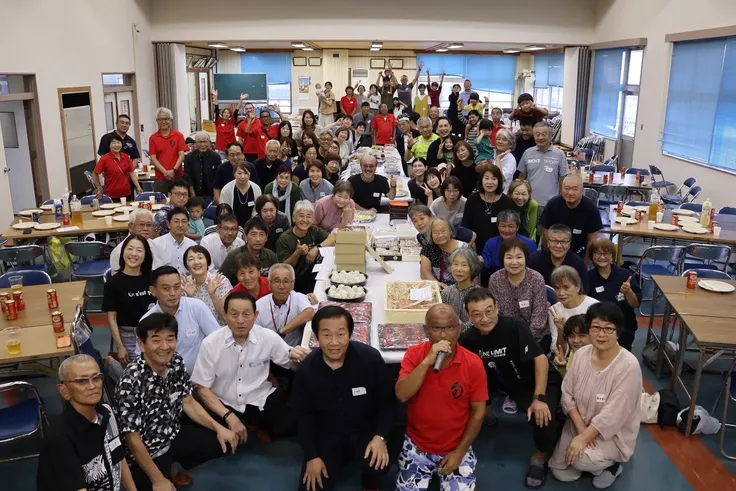
Kawaminami has a unique event called “Tasting the four seasons” (四季を食べる会, shiki wo taberu kai), which began 20 years ago. Four times a year, local farmers and fishermen gather to share home-style dishes made from seasonal ingredients.
The cost is around 4000 yen per participant (or 1500 yen, if you bring a dish to share) and that includes unlimited beer and shochu. My wife and I joined the organizing team soon after moving here, and it’s been a fantastic way to meet new people from our town and the surrounding area.
During our most recent summer gathering, I even got the chance to debut our homegrown watermelon, which was thankfully well received.
Participating in various sports events
Our town hosts both a yearly 10 km foot race and a gourmet cycle race. For the latter, participants cycle 30 to 150 km (depending on their experience and fitness levels) through several towns in the Koyu region of Miyazaki. During the trip, riders stop frequently to rest and sample some local delicacies. We’ve loved joining these events with friends in the area, and often meet new ones as well, since everyone goes out for dinner and drinks after the races.
We’ve also been involved in many sport exchange events. Since part of my wife’s mission was to internationalize our town, she helped to host an international boys’ baseball match by welcoming a team from Hawaii. She even facilitated a homestay program for them, the first in Kawaminami. At other times, she organized international volleyball and kickball events.
While there aren’t many native English-speaking people in our area, there is a large population of people from Southeast Asia who’ve come to work on its many farms. These events have been a great way to connect with them, and it’s been awesome to see the Japanese residents receive them warmly as well.
Volunteering for our town’s festivals
Starting in early spring, a team of around 40 volunteers organizes a spectacular fireworks festival to celebrate the end of summer. The team meets frequently over the course of several months to plan the event, which hosts 20,000 attendees, more than 30 food vendors, and several dance performances.
This past summer I volunteered for this team, and found it a great way to learn about the dynamics between local businesses, town committees, and the municipal government. Often, after the meeting, members will go out for dinner and drinks. These post-meeting gatherings have been great opportunities to get to know the other volunteers on a deeper level, as generally everyone is a bit more relaxed after having a beer.
Just a few months after this firework festival, another volunteer team organizes a burger festival that hosts over 20 restaurants and food trucks from across Miyazaki prefecture. This event operates at a smaller scale than our town’s firework festival, but both committees work quite hard, with the simple goal of running a great event to help increase inbound tourism and support the local economy. The town wouldn’t be as exciting without the sacrifice and dedication of these volunteers.
Overall, it seems like we’ve rarely had a completely free weekend since moving to Kawaminami. Whether it’s a local event or an evening hanging out with friends, our social calendars here are full, and we wouldn’t have it any other way.
The downsides of living in rural Japan
While we love our life here, it wouldn’t be fair to paint the countryside as perfect. A few things take some getting used to.
Secrets don’t stay secret for long
In a small town, people talk. It rarely feels like malicious gossip. It’s more that everyone knows everyone, and so news travels naturally. But if you tell one person something, don’t be surprised when someone you never told brings it up a few weeks later.
You’ll need a car
There’s no train arriving every few minutes out here, and the nearest station can be a long walk away (as my wife found out). We rely on our car to get almost everywhere.
The silver lining is my wife has become more comfortable with driving, something that didn’t seem likely back when we were considering living in Canada.
Warmth can take time
Some locals, especially older residents, can be shy around foreigners at first. It isn’t unfriendliness: many simply haven’t had much chance to interact with people from overseas.
In my experience, the ice melts quickly once you’ve shared a meal or a drink together. Be patient and open to conversation, and people will come around.
In conclusion
A few weeks ago, a bright light flashed across the sky again. But instead of lying awake and annoyed, I was standing in a field with 20,000 other people, sweaty from a day of setting up tents and directing traffic, watching the fireworks my community had spent half a year planning.
Moving to the countryside hasn’t been perfect. We drive everywhere, it’s hard to keep a secret, and there are still days when I’m the only foreigner in the room. But in Osaka we were surrounded by millions of people and knew almost none of them. Here, it’s difficult to get to the supermarket without stopping to chat with someone we know.
Once you arrive, it’s best to say yes to everything, from a random offer to drive you to the station, to volunteer opportunities. That’s when a town stops being just a place you live, and starts feeling more like home.