
This article was originally written in Japanese, and translated by TokyoDev.
Foreigners who are thinking about applying for permanent residency in Japan typically have the following questions and concerns:
- What is the approval rate for permanent residency applications?
- Will my application be approved?
- What are the reasons for disapproval?
- What should I do to prepare a successful application?
What you will learn from reading this article:
- Why permanent residency approval rates are rising
- Different approval rates at regional immigration bureaus
- Main reasons for denial and countermeasures you can take
- Specific preparation methods
Analyzing the data on Japan’s permanent residency approval rate
For foreigners considering applying for permanent residency in Japan, the trend in approval rates is an important indicator of your chances. Here, we analyze the data from 2021 to 2024 and consider yearly changes in approval rates, as well as contributing factors.
Permanent residency application approval rate data (2021-2024)
| Year | Total number of applications | Number of approvals | Number of rejections | Permission rate (%) |
|---|---|---|---|---|
| 2021 | 64,149 | 36,691 | 25,451 | 57.2% |
| 2022 | 58,927 | 37,992 | 19,148 | 64.5% |
| 2023 | 50,986 | 33,470 | 15,832 | 65.6% |
| 2024 | 55,906 | 36,766 | 17,282 | 65.8% |
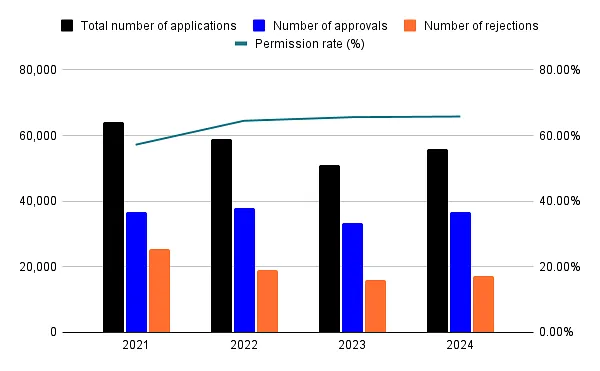
The above information has been extracted and compiled from the Immigration Control Statistics Table. The table above does not include “Other” cases such as application withdrawals.
Changes in the approval rate
The approval rate is increasing year by year
In 2021, it was 57.2%, but it rose to 64.5% in 2022 and exceeded 65% in 2023 and 2024. This is an 8.6 point increase over four years.
The number of applications overall is increasing
The number of applications in 2023 was 50,986, but that increased to 55,906 in 2024. This may be due in part to the impact of the COVID-19 pandemic depressing the number of applications in 2023, as well as changes in living conditions in Japan, such as the weak yen, rising prices, and stricter social insurance.
The rejection rate has decreased slightly
Though there were more applications overall in 2024 than in 2023, the rejection rate decreased slightly from the previous year.
Reasons for the rise in permanent residency approval rates
More applicants are preparing in advance
In the past, there were many cases where people applied without meeting the requirements. Recently, there may be an increase in the number of people who first consult with administrative scriveners to ensure they are properly prepared.
In particular, the heightened emphasis on tax status and proper social insurance enrollment has led to more well-prepared applications, which may be having an effect on acceptance rates.
Special provisions for highly-skilled foreign workers
Foreigners with the Highly-Skilled Professional status of residence can apply for permanent residency within one to three years, so it is possible that there are more applications from people who can easily meet the screening criteria.
The reasons for denial have become clearer
Compared to the past, the reasons for denial have been explained more clearly (tax payment, pension, bad conduct, etc.). It is possible that the approval rate has improved as a result of applicants taking precautions in advance.
Permanent residency application trends and outlook
Trends in 2024
- The number of applications increased, and the approval rate also increased slightly.
- In particular, highly-skilled professionals and those with stable incomes are more likely to be granted permission.
- Those who have not paid taxes or social insurance will continue to be subject to strict screening.
Future outlook
- Even after 2025, screening will remain strict. Tax, pension, and insurance payment statuses are particularly important.
- The approval rate could improve further, but the quality of applicants will be an issue.
- Advance preparation will become increasingly important.
Analysis of permanent residency approval rates by regional immigration bureau
The approval rate for permanent residency applications varies depending on which immigration bureau you apply to. We’ve analyzed the approval rates for permanent residency at each of the major immigration bureaus across the country, and can explain the trends in each region.
Permanent residency approval rates by immigration bureau (2021-2024)
| Regional Immigration Bureau | 2021 | 2022 | 2023 | 2024 |
|---|---|---|---|---|
| Sapporo | 71.56% | 64.33% | 66.09% | 65.89% |
| Sendai | 62.87% | 67.14% | 67.18% | 63.61% |
| Tokyo | 57.31% | 68.18% | 71.16% | 68.01% |
| Nagoya | 50.12% | 56.61% | 59.09% | 63.60% |
| Osaka | 67.57% | 63.80% | 64.18% | 64.88% |
| Hiroshima | 55.88% | 54.01% | 60.94% | 68.19% |
| Takamatsu | 60.56% | 69.29% | 61.43% | 66.26% |
| Fukuoka | 58.11% | 58.19% | 52.10% | 59.34% |
| National average | 57.20% | 64.47% | 65.65% | 65.89% |
The above information has been independently extracted and compiled from immigration statistics tables.
Trends and analysis
The approval rate at the Tokyo Regional Immigration Bureau has risen sharply since 2021, becoming one of the highest in the country
- Their approval rate in 2023 was 71.16% , the highest in the nation, but for 2024 it came second at 68.01%.
- Compared to 57.31% in 2021, this represents an increase of approximately 11 percentage points over four years.
- This is likely due to the large number of applications from highly-skilled professionals. Tokyo has many IT, financial, and research institutions, so it seems that foreigners with stable incomes tend to apply.
The Sapporo Regional Immigration Bureau has a relatively stable and high approval rate
- The approval rate has remained stable at over 60% with little fluctuation.
- The number of permanent residency applicants in Hokkaido is relatively small, and they may be carefully screened.
The Sendai Immigration Bureau has a stable and high approval rate
- Their rate trended upward from 2022 onwards, but dropped slightly in 2024, falling below the national average.
The Nagoya Immigration Bureau’s rate is clearly on the rise, but is still below average
- It has fallen below the national average for four consecutive years from 2021 to 2024.
- This may be due to the large number of foreign workers in the automotive industry, who are unable to meet the annual income requirements.
The Osaka Immigration Bureau’s rate is showing a slight downward trend
- It was relatively high in 2021, but fell below the national average from 2022 onwards.
- The number of applications from international students and technical trainees has increased, which may have led to a subsequent increase in the rate of denials.
The Hiroshima Immigration Bureau had the highest approval rate in 2024
- It dropped in 2022, but in 2024 this bureau had the highest permit rate in the nation.
- Until 2023, it was thought that the lower rate was due to the fact that it was a regional city and there were not many foreigners with stable incomes, but in 2024 the approval rate suddenly increased.
The Takamatsu Immigration Bureau’s rate has large fluctuations
- In 2022, the permit rate was among the highest in the nation, but it dropped in 2023 and then in 2024 it was above the national average.
- The number of applications overall is low, and therefore individual cases may have an outsized impact.
The Fukuoka Immigration Bureau has the lowest approval rate in the country
- Following 2023, 2024 also recorded the lowest figures in the country.
- There are many applications from technical intern trainees and international students, and it is possible that many of them do not meet the income and tax payment requirements.
- If you do not prepare thoroughly, your application may be denied. We recommend consulting an expert and having your application checked in advance.
Reasons for differences in acceptance rates at each Immigration Bureau
The applicant’s occupation and income
Tokyo tends to have a high number of highly-skilled applicants, as well as those with stable incomes. In Fukuoka and Nagoya, by contrast, there may be an increasing number of cases where the income requirements are not met.
The screening criteria
The basic screening criteria are the same at all immigration offices, but there are likely to be slight differences in the strictness of the screening process from region to region. For example, the Fukuoka Immigration Bureau may be conducting careful screening because they have had many cases of visa denials in the past.
Main reasons for denial
The main reasons for denial are as follows:
- Unpaid or overdue taxes or social insurance payments
- Unstable income (annual income of less than three million yen, frequent job changes, etc.)
- Serious traffic violations in the past or a criminal record
- Incomplete documents (errors, omissions, false applications)
Tips for increasing your chances of approval include:
- Paying your taxes and social insurance in full
- Preparing proof of income for the last three to five years
- Delaying your application if you have a recent history of traffic violations
Frequently asked questions
What are the most important aspects of the application process for permanent residency?
There are many points to consider, but the following three are particularly important:
- Fulfilling tax obligations (resident tax, income tax, pension, and health insurance)
- Having a stable income of approximately three million yen or more per year
- Having a record of good conduct, with no criminal or traffic violations
Will I be unable to obtain permanent residency if I had a traffic violation in the past?
If it is a minor traffic violation (e.g. one parking violation or one speeding violation), that won’t have much impact after a certain amount of time has passed. However, if there is a serious violation, such as drunk driving or driving without a license, it’s highly likely that permission will be denied.
My previous application for permanent residency was denied. Can I reapply?
You can reapply. However, if you do not correct the reason for the denial, you’ll get the same result. For example, if your application was previously denied due to late tax payments, we recommend that you reapply after paying your taxes on time for at least two to three years.
Summary: Key points for applying for permanent residency
The Fukuoka Immigration Bureau has the lowest approval rate in the country, so if you do not prepare thoroughly, there is a high risk of your application being denied.
If you want to successfully apply for permanent residency in Fukuoka, please make thorough preparations in advance and consider seeking professional support.