
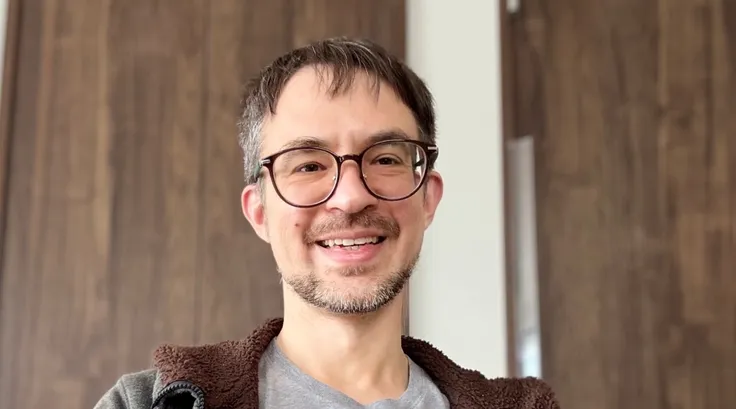
When Matt Gillingham arrived in Japan in August 2006, he didn’t intend to get back into software development, but the introduction of the iPod Touch in Japan unexpectedly opened the door. Twenty years later, he’s an Engineering Manager at Mercari and enjoying both his career and family life in Japan.
TokyoDev asked him to share his insights on succeeding in Japan, including:
- How he fell back into software development
- How his international experience helped him get ahead in Japan
- The advantages of being a manager
- Why the engineer shortage is improving Japanese workplaces
- The downside of being non-Japanese
- The surprising way Japanese skills can influence your career
- How parenting in Japan has created new questions
- His advice for other developers in Japan
This was not his plan
“I actually ended up accidentally becoming an engineer again,” said Gillingham. “I had programming experience even before college. I worked in a computer consulting company locally when I was in high school, and I was a computer science major, but when I graduated I wasn’t necessarily sure that I wanted to do that.”
What he did want to do was travel overseas. “I assumed I was only going to be in Japan for a relatively short period of time, but after I graduated college, I thought living abroad would be an important life growth experience.”
So initially, Gillingham came from the US to Japan to teach English. Then, in 2007, Apple released the iPod touch in Japan. “I got one and I was interested,” said Gillingham. In the spring of 2008, Apple followed up with the iPhone SDK.
And then I made a game in a weekend, and started showing that to people. Suddenly, every two or three weeks, I was getting contacted out of the blue by people I did not know who’d heard that I knew how to make iPhone apps.
Leveraging knowledge gaps
“So I think that my timing happened to be very good,” Gillingham said.
At that time, Apple products and things [like it] weren’t quite as big in Japan yet, but people became familiar with the app store . . . and saw business opportunities, but there weren’t actually very many engineers.
Mobile developers were so highly in demand that all of Gillingham’s initial business came just by word of mouth. “I got contacted out of the blue, really frequently. And I was like, ‘Okay, well this is very interesting.’ So I basically took a couple of freelance jobs, making apps for people. Then I eventually got a job at a startup company called Tonchidot.
“They made this app, which was actually kind of a big deal in 2010 or 2011. It was called Sekai Camera, and it was a very early augmented reality app, and it also won an award at TechCrunch Disrupt. It had a couple million downloads in Japan, which at that time was significant.”
It wasn’t just Gillingham’s mobile development skills that were in demand: he was also able to use his English abilities to great effect. “When I worked at Tonchidot, everybody thought that I was some kind of genius, and the reason why was because I could search Stack Overflow. This is one of those situations that only existed very temporarily, but at that time the iPhone was still relatively new and there wasn’t a lot of programming content available about it in Japanese.”
If there was some problem, I would just search Stack Overflow and find the post and solve it. And all my colleagues were like, ‘How did you do that? How did you know that?’
Why he likes being a manager
Despite its early success with Sekai Camera, Tonchidot struggled to find a business model that worked. “Arguably the idea was very ahead of its time and might still actually be ahead of its time,” Gillingham explained, “because we still don’t have a really big augmented reality platform, even though the technology’s much more advanced now. Maybe in the future.”
Nonetheless, Gillingham’s time there served as a springboard to other roles. From 2010 to 2018 Gillingham worked for several Japanese companies, and also co-founded an event platform. In 2018, he was hired by Mercari as an iOS engineer. “But actually pretty quickly I became an engineering manager. I was only an engineer for four months.”
While there are some downsides to being a manager, including less time for actual engineering, Gillingham has found that he enjoys mentoring. “I think there are ways of doing management that are good because you can conceive of it as helping people with their careers and trying to give them advice about what they can do that will improve their skillset or help them in the job market.”
He also appreciates the opportunity to have an impact upon the business as a whole.
As a manager, you can look at [the company] at an organizational level, and you have the capacity to adjust the organization to be more efficient. As an engineer, usually you don’t really have much capability to change the organization itself.
The work environment has gotten better
The same engineer shortage that helped Gillingham get his foot in the door in 2007 still exists today. One of the interesting side-effects, he told TokyoDev, is that workplace environments have improved.
A lot of Japanese companies have realized that they need to hire globally, and because they need to hire globally, they need to address their working environment, and they need to create the kind of working environment that’s able to attract and retain foreign workers.
“And I think that’s gradually getting better. I wouldn’t say that there’s not more work to do in that area, but I would probably say that there are comparatively more opportunities there. . . . [And] roughly speaking, using English [at work]? No problem. That’s not something that existed when I first came to Japan, in any company.”
Gillingham clarified that he’s referring to the work environments at newer IT companies, like Mercari, PayPay, and MoneyForward. “That’s been a trend and I think that trend is continuing. I can’t really see that trend reversing because I think it’s caused by a shortage of engineers, and I don’t think the shortage of engineers problem is likely to be resolved because of the Japanese population situation.”
Communication difficulties
As Gillingham discovered at Tonchidot, one initial upside to being an international developer was knowing how to access English-language resources online. The downside, he said, is that “ it may be harder to convince your colleagues that your ideas are correct, and it’s not anybody’s fault necessarily.
“Sometimes ideas are hard to explain, and you can’t explain them very well in Japanese, and they don’t understand English well enough. . . . So if you have a good idea or you feel there’s something that you want to do, you might just not be able to get people to understand that idea, or you might not be able to say it in a way that it’s convincing.”
It’s not purely a language issue, either. “To a certain extent, I think what is convincing is a culturally-defined thing. What is a convincing argument to an American versus what is a convincing argument to a Japanese person . . . there is in some cases a cultural aspect to that.”
According to Gillingham, this difficulty in conveying ideas is one of the most frustrating aspects of being a non-Japanese developer.
You may end up in this situation where you don’t have the opportunity to shape the organization, or to shape the plans, or to do things that you would like to do, and you have to understand that that can be a limiting factor as well.
Japanese skills create opportunities . . . if you want them
Though he mentioned communication frustrations, Gillingham does speak some Japanese. “ My Japanese ability is ‘okay,’” he said. “It’s not great, honestly. I’m a little bit embarrassed about it after being here so long. But I can have conversations, I can have business meetings. I have one-on-ones in Japanese, but there are still obvious grammatical problems. . . . Certain jobs are just not available for me. I couldn’t be a salesperson. There’s no way I would have the capability to actually have a formal business meeting and use keigo [formal Japanese] and all that.”
Fortunately, for the jobs Gillingham wants, English abilities are more highly valued.
A lot of the best opportunities in Japan [are] companies that are global, or who want to be global, that find value in having native English-speaking employees because their business already involves being international. A lot of times, those also happen to be some of the best engineering opportunities.
“I think there’s a correlation between, if you ended up with really good Japanese, you would probably open up more opportunities. But then the types of companies that you [would] have opportunities in are traditional Japanese companies, which are probably actually less good for many reasons. It’s probably more of a cultural conflict with your expectations and their expectations. Honestly, their salaries are probably lower, too.”
Living in, and leaving, Japan with a bilingual child
Gillingham’s top priority is his family, which became clear when I asked Gillingham if he had any plans to leave Japan. “ I’m married and I have a son,” he said, “so certainly now that’s something that’s keeping me in Japan. And I bought a house and stuff like that.”
It’s not just a question of family ties, though. “I think my life is interesting. I think my job is pretty interesting and I like my lifestyle, so for me it’s mostly positive. I would of course say there are various frustrating points, but I mean, I expect if I was in the US I would also have frustrating things. I would say I’m positive about working in Japan.”
It helps that, just as the work environment is getting easier, Gillingham thinks that the “parenting environment” in Japan is improving. “We had a pretty good experience getting daycare, and the local government is helping with that. I think the Tokyo government’s going to subsidize that now.
“So I would say that aspect of it, the childcare stuff, is probably improving compared to how it was. But I can’t necessarily compare with the past,” he clarified. “I know how things are now because now I have kids. . . . But [Japan is] being really proactive about that kind of stuff.”
That being said, he wouldn’t rule out moving in future. His wife, according to Gillingham, would be open to living anywhere if a good opportunity presented itself. When it comes to relocating his son, though, Gillingham has to evaluate some intense pros and cons. “I want him to know English well enough to have opportunities to, for example, go to the US, or go to Europe, and to speak English basically well enough so he could have whatever educational opportunities or work opportunities are available in the world.”
I also don’t know what kind of identity he would have if we moved around a lot. That’s the kind of stuff I think about: is it nice that he grows up in the place where he was born? . . . Honestly, that kind of thing maybe matters more to me now than other questions, even [more than] my career.
His final advice: consider your career ladder, and read this book
Gillingham emphasized that if you want to stay in Japan long term, you should start by taking a close look at your potential career ladder. ”How does your company define its growth path? And I think that for a lot of companies, the honest reality may be . . . you work as an engineer, and the way up is to be management.
“I don’t actually think that’s necessarily true at Mercari. They have an engineering ladder. You can actually look that up online. There is a way of being what will be called an ‘individual contributor,’ where you do not necessarily become a manager, but you still have a growth path. But I don’t think all companies think that way.”
For people who don’t want to be managers, that’s what you have to understand: what is the career path in your current company? Make your decisions based on what you observe.
“Hopefully they’re explicit about it, but if they’re not explicit about it, you’re just going to have to infer it based on seeing how people get promoted and get raises.”
His other recommendation is quite simple: “Read The Culture Map. That book is good. . . . I think a lot of times, people are too quick to assume that things are cultural differences that could actually be explained more by circumstance.
“[But] I think that the best explanation I’ve seen is The Culture Map. It’s one of the few times when I read something about culture and was like, ‘Okay, this actually matches my experience and makes sense.’ It’s not just about the US and Japan, but I think it provides a really good framework for understanding cultural differences and their manifestations.”