
In 2019 I arrived in Japan on a MEXT scholarship, to study for a master’s in Information Systems Engineering. I spoke almost no Japanese.
My research was in healthcare robotics, though my career ended up taking a different turn. Today I work as a Senior Business Intelligence (BI) Data Engineer, and I’ve spent the years since at a handful of companies across the Japanese tech industry.
The scholarship is what brought me here, but the official brochures and application guides don’t really tell you what the experience is like once you actually land. It’s not just free tuition and a monthly stipend, but learning a new academic culture, living with a language barrier, and working out how to go from being an international student to someone a Japanese company will actually hire.
Here’s what those two years were really like: the hard parts, the opportunities, and how I used them to start a career in Japan.
The reality of the Japanese lab
Doing graduate school in engineering in Japan means joining a research lab (研究室, kenkyuushitsu) and it worked differently from what I’d expected.
Different expectations
In a lot of Western programs, you mostly take classes and write your thesis on your own. A Japanese engineering lab is more like a small community. You get your own desk, you keep regular hours, and there is a clear hierarchy, from the professor down through the post docs and the senior and junior students. The lab is not so much a place you drop by to do research, but rather where your whole academic life happens.
That can be a lot for an international student to adjust to, but I was lucky. Around 40 percent of the students in my lab came from outside Japan, so I was never the only foreigner in the room, and that helped.
Mingling with your labmates
My professor also assigned one of my senior labmates as my tutor when I arrived, and that made a huge difference in those first few weeks. My labmate helped me find my footing inside the lab, walked me through how to use the equipment, and took me over to the experiment room so I’d know where everything was and how it worked. He even helped me figure out the cafeteria.
Outside the university he stepped up for the practical things too, like opening a bank account when the forms and the entire counter conversation in Japanese were well beyond me. Having one person whose job was looking out for me took a lot of the fear out of those early days.
Even with all that support, the first few weeks were quietly hard. Nobody was unkind, far from it, but there’s a particular kind of loneliness in being surrounded by people and not quite being able to reach them yet.
What helped is that engineering has a language of its own. Code doesn’t care where you are from. My labmates and I might have struggled to make small talk over lunch, but the moment we were staring at the same bug or the same research paper, the barriers fell away.
Bit by bit, the lab stopped feeling like something to survive and started feeling like a place I belonged.
Absorbing the culture
What I learned in that lab ended up mattering far beyond my degree. Precision is something you notice everywhere in Japan, from trains that are exactly on time, to the care people take over the smallest everyday tasks.
The Japanese research culture is no different: it runs on precision and persistence. There’s a real patience for getting the details right, and a habit of breaking a hard problem down step by step until it finally gives way.
One seminar early on taught me this in a way I’ve never forgotten. I had to present on a topic where every approach I’d tried had failed. All I had to show was a list of things that didn’t work, and I walked in convinced it would be the worst presentation of my life.
My teacher’s feedback turned that thinking on its head. Where I saw failure, he saw someone learning from experience and working toward the right answer.
That idea stayed with me, and it still steadies me at work today, every time something doesn’t go right on the first try.
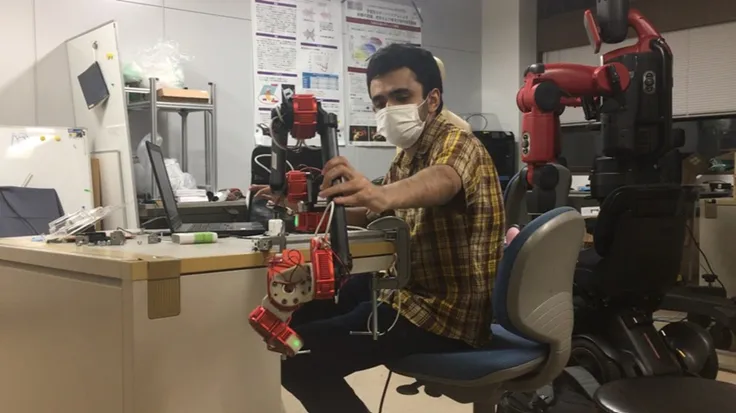
Persistence also marked the smaller rituals of lab life, not just the actual research. We cleaned the lab ourselves on a rotation, with two students assigned to the duty each month, and when your turn came you did it properly rather than rushing through. The message sent was that the space around you is worth keeping in order, and that every member of that space is responsible, no matter how senior. It sounds minor, but there’s a real lesson in discipline in that.
Learning to think carefully, to hold myself to a high standard, and to stay with a problem until it yields is exactly what a career in engineering demands, so when I moved into the working world, I carried those takeaways with me.
If you want to learn precision and discipline in the fullest sense of those words, Japan is a very good place to do it.
The scholarship advantage
The MEXT monthly stipend of 144,000 yen was modest, but it was enough to live on without stress, and that shaped my whole experience. I wasn’t stuck working a part-time job just to cover rent, which left me time and space both to be fully present in Japan, and to consider my future here.
Experiencing Japan
I used some of that extra time to travel around Japan, and also to join a group for learning Japanese. This was a free weekly group run by volunteers, and it became a little community in itself. They were forever inviting us to barbecues, parties, hikes, and city tours.
If I had to offer one piece of advice on learning Japanese, it’d be this: the best way to settle in and pick up the language is to spend time with Japanese people. Those everyday exchanges taught me more than any textbook could.
Unfortunately, though my Japanese progressed considerably, I also knew I wouldn’t be proficient by the time I started looking for a job.
Starting the job hunt early
I quickly knew that I wanted to stay and work in Japan after graduating, and I also knew my biggest weakness: my Japanese was not fluent. In the Japanese job market, that can quietly close a lot of doors before you even reach them.
I decided that if I wanted a real shot, my greatest asset was time. Japanese students begin job hunting (就活, shuukatsu) famously early, often more than a year before they graduate. Many international students miss that window. I went the other way and started even earlier than the usual Japanese timeline.
My Japanese had grown a bit in this time, but I knew it still wasn’t strong enough to carry a full interview in Japanese. So instead of waiting, I decided to start my job hunt early and make up for it with effort and timing.
My early bird job hunt
First steps
Some applications led to interviews, some to online web tests, and plenty to outright rejections, but slowly the replies began to come in.
It was an intense stretch. I applied widely and sat through many interviews, at both established Japanese names like YAMAHA and newer, more global-facing tech companies like Money Forward.
The language question
Some interviews I did entirely in Japanese when the company asked for it, leaning on memorized phrases and vocabulary and pushing through with broken grammar. Others I handled by mixing Japanese and English, and some I did fully in English.
My rule was simple: take every opportunity that came my way, in whatever language it arrived. Each one, the wins and the rejections alike, taught me something.
What these companies are looking for
The biggest surprise was that the interviews weren’t technical. I came from a background where interviews can mean whiteboard algorithms and tricky questions, so I expected to be tested hard on code. Instead, most of the conversation was about fit: what I expected from the role, what I’d learned during my time in Japan, how I thought about my career, and whether I’d work well with the team.
In the end, the effort paid off. I landed an offer from Rakuten a full year before my graduation date.
The results
Looking back, securing that offer twelve months early was the turning point of my time as a student, and the scholarship made it possible in a way that’s easy to overlook.
The interviews themselves may not have called for heavy technical preparation, but starting my job hunt a full year ahead still took real time and mental space, from researching companies to learning how the whole system worked. The MEXT scholarship gave me all of that at exactly the right moment.
Once I’d signed a contract, my final year changed completely. Instead of getting worried about being unemployed, I spent my last year genuinely focused on my research, enjoying the lab, and living in Japan. I could pour my energy into my thesis and take the trips and slow weekends that became some of my favorite memories of the whole experience.
Life after graduation
Starting out at Rakuten as a Data Engineer turned out to be the perfect bridge between university and the Japanese tech industry. The engineering environment was English friendly, so I could find my feet professionally while gradually getting used to Japanese corporate culture as well and improving my language skills on the side.
What surprised me most in those first months was how much of the real learning had nothing to do with code. It was reading the room in meetings, realizing that a gentle “Let’s consider it” usually meant no, and adjusting to a pace and a level of politeness that were new to me. The engineering I could handle. The culture took longer, but the English-friendly environment gave me the room to learn it without sinking.
Today I work as a Senior BI Data Engineer, having moved well past that first role. These days I mostly build the data infrastructure that companies depend on, designing the pipelines and systems that turn raw data into something teams can actually use.
It still amuses me that I came to Japan for robotics and ended up building data systems instead, but in hindsight the path makes sense. The technical foundation I built during my master’s, together with the resilience I picked up surviving the job hunt, is what allowed me to grow into the roles I’ve held since.
Final thoughts
To anyone thinking about coming to Japan, or already studying here: a scholarship, or any kind of financial support, is a wonderful starting point, but what you make of it is entirely up to you.
Don’t wait until graduation to think about what comes next. Learn how the system works, and be honest about your weak spots (mine was language). The move from student to working professional in Japan isn’t easy, but with the right timing and a bit of focus, it’s absolutely within reach.
If I had to distill two years into a handful of lessons:
- Treat the lab as your community, not just a place to work. The technical side is where you’ll connect first, and everything else follows.
- Soak up the research culture. The precision and persistence you pick up in a Japanese lab will outlast your degree and carry straight over into whatever roles come next.
- Think of the stipend or any financial support as time, not just money. Its real value is the freedom to focus where it counts.
- Start your job hunt on the Japanese timeline, not your home country’s. A year early is not at all early.
- Don’t overprepare for the wrong kind of interview for new graduate roles. At many Japanese companies, especially the larger ones, interviews are about fit, your expectations, and what you’ve learned, rather than whiteboard algorithms.
- Your language gap can be a real barrier, but it isn’t the end of the story. Time, effort, and an English-friendly first employer can close it.